There is a question that has run quietly underneath every conversation in this series: if financial literacy is so clearly essential, why is it still not being taught? We have heard the answer from a literary scholar who studies how women find their voice. From a paediatrician who watches financial stress arrive in his clinic before it arrives in a bank statement. From an entrepreneur who learned the hard way that guarding money and growing it are not the same skill.
This episode gives us the answer from someone who sits inside the school system itself—and has spent 17 years trying to change it from within.
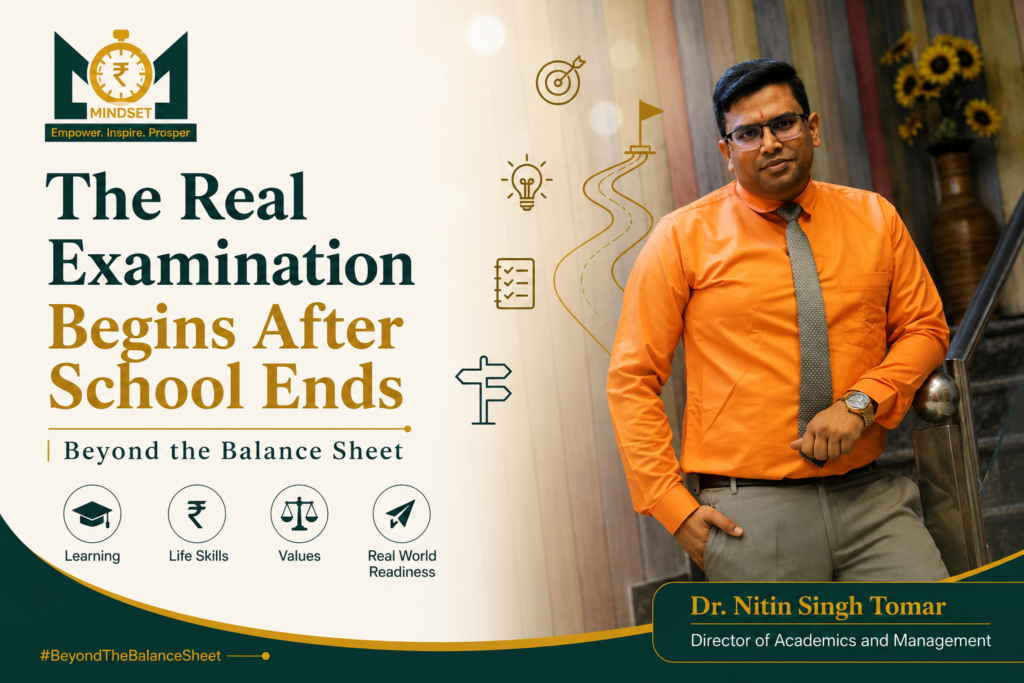
Dr. Nitin Singh Tomar is an educationist, Director of Academics and Management, and a Ph.D holder who has taught, mentored, and shaped educational frameworks for over 15,000 students and professionals across Meerut and beyond. He has published international research papers, designed faculty development programmes, and spent the better part of two decades asking a question that most school systems would rather avoid: are we preparing children for exams or for life?
His answer — detailed, structured, and backed by research — is one of the most practical frameworks I have encountered in this series. He calls it the 70:20:10 Life Readiness Framework. And by the end of this conversation, you will understand not just why financial literacy belongs in schools, but exactly how it should get there.
THIS EPISODE’S GUEST
Dr. Nitin Singh Tomar
Educationist | Director of Academics & Management | Ph.D., M.Tech, MBA (HR & IT) | Meerut
Dr. Nitin Singh Tomar has spent 17 years at the intersection of education, leadership, and skill development in Meerut — working across colleges, schools, and corporate institutions. He holds a Ph.D, M.Tech in Industrial & Production Engineering, and an MBA in HR & IT, bringing both academic rigour and administrative experience to his work. He has catered to over 15,000 students and professionals through classroom teaching, curriculum planning, faculty development programmes, and workshops on personality development, communication, and life skills.
An expert in NEP and NCF curriculum alignment, Dr. Tomar has published 7+ international research papers on 21st-century education, presented at national and international conferences, and conducted 50+ workshops for students, teachers, and parents. His current role as Director of Academics places him at the centre of exactly the kind of institutional change this series is advocating—and his research on private school teacher satisfaction gives him a uniquely ground-level view of what is and is not working inside India’s schools.
“The future will not reward students merely for what they remember; it will reward them for how wisely they decide.”
Q1. Schools prepare children for exams, but are we preparing them enough for real life? Where do you think financial literacy and practical life skills should fit into a child’s education?
Dr. Nitin Singh Tomar:
For decades, schools have measured success through report cards; the 21st century demands that we measure it through life readiness. A child who can solve quadratic equations but cannot understand taxation, insurance, digital fraud, investments, or emotional decision-making enters adulthood academically qualified yet practically vulnerable.
The urgency is undeniable. The OECD PISA 2022 Financial Literacy Report reveals that over 85% of 15-year-olds shop online and nearly two-thirds already use digital financial services, yet almost one in five fail to demonstrate even baseline financial literacy. Students exposed to financial concepts in school consistently make wiser saving and spending decisions.
In India, where UPI transactions have transformed teenagers into digital consumers, financial education can no longer remain optional. Every QR code scanned without understanding interest, inflation, cyber fraud, or budgeting is a silent reminder that technology has outpaced education.
Financial literacy should, therefore, not become another textbook subject—it should become a life laboratory integrated from primary school onwards. Imagine a curriculum where:
- Primary Classes learn the difference between needs and wants through classroom markets
- Middle School students prepare household budgets, understand banking, digital payments, and responsible spending
- Senior Students file mock income tax returns, compare insurance plans, analyse investments, understand entrepreneurship, negotiate salaries, manage credit, and evaluate financial risks
But financial literacy is only one pillar. Schools must equally nurture communication, critical thinking, emotional intelligence, legal awareness, digital citizenship, first aid, entrepreneurship, problem-solving, time management, and ethical leadership. These are not “extra” skills—they are the operating system of adulthood.
The real examination begins after school ends. Our mission as educators should be to produce financially prudent citizens, emotionally resilient individuals, and ethically grounded leaders—not merely examination toppers. If education prepares children only to pass exams, it serves one season of life. If it prepares them to manage money, relationships, responsibilities, and uncertainty, it serves a lifetime.
PRERNA’S LENS →
The phrase that stopped me in this answer was “academically qualified yet practically vulnerable.” In four words, Dr. Tomar has named the exact gap that this entire series has been circling. Nidhi Vadhera named it from the entrepreneur’s chair. Dr. Manjari Shukla named it from the literature classroom. And now an educator who has spent 17 years inside the system is naming it from the inside — with data, with structure, and with a curriculum design to match.
The OECD figure he cites — one in five 15-year-olds failing to demonstrate even baseline financial literacy, despite the majority already using digital financial services — is the most precise articulation of the problem I have seen. These are not children without access. They are children with access and without education. They can tap UPI. They cannot explain interest. That gap is not a technology problem. It is a curriculum decision.
What I find most valuable in Dr. Tomar’s framing is the word laboratory. Not a subject. Not a module. A laboratory—where children do things with money, make decisions, face consequences, and build the muscle memory of financial judgement. This is exactly what I try to create in the workshops I run with young people. The lesson that sticks is never the one that was explained. It is the one that was experienced.
“A child who can solve quadratic equations but cannot understand taxation, insurance, or digital fraud enters adulthood academically qualified yet practically vulnerable.”
— Dr. Nitin Singh Tomar
Q2. Today’s children are growing up with UPI, online shopping, social media, and AI. What role should schools and parents play together in helping children understand the value of money and become responsible decision-makers?
Dr. Nitin Singh Tomar:
Today’s children are the first generation to grow up in a cash-light, AI-powered world, where a single tap on UPI can complete a purchase, social media shapes aspirations, and algorithms influence decisions. Convenience, however, must never replace consciousness.
Schools and parents must become co-educators in financial wisdom. While schools should integrate budgeting, digital payments, cyber fraud awareness, consumer rights, and ethical AI into experiential learning, parents must reinforce these values at home through open conversations about money, modelling responsible financial behaviour, and involving children in household financial decisions from an early age.
The danger today is not that children lack access to money or financial tools. The danger is that they have access without understanding — they can spend in seconds but cannot explain what interest means, what a credit score does, or why an EMI costs more than the sticker price of the product. Social media amplifies this by making every lifestyle visible and desirable, creating wants that outpace both income and financial wisdom.
The solution lies in building what I call financial consciousness — not just financial knowledge. A child who understands the difference between impulse and intention, between a want and a need, between the appearance of wealth and actual financial health, is equipped for this world in a way that no textbook alone can achieve. Schools must create that consciousness through real-world simulation, and parents must sustain it through the conversations they choose to have — or not have — at home.
PRERNA’S LENS →
Dr. Tomar introduces a distinction here that I want to stay with: the difference between financial knowledge and financial consciousness. Knowledge is knowing what an EMI is. Consciousness is pausing before you tap “buy now” and asking whether this purchase aligns with your goals, your budget, and your actual values — not the aspirational life the algorithm is showing you.
In my Gen Z workshop blog earlier this month, I wrote about how the algorithm is making financial decisions for young people who haven’t noticed yet. Dr. Tomar is naming the same thing from the school leadership side: convenience has replaced consciousness. And the answer, in both cases, is not to remove the technology. It is to build the human capacity to use it with intention.
His point about parents as co-educators is one I feel personally. Every workshop I run with parents reveals the same pattern: they want their children to be financially literate, and they are the most powerful financial educators their children will ever have — but nobody has given them the language or the confidence to start that conversation at home. The gap between wanting to teach and knowing how to teach is where Mom Money & Mindset lives. And it is exactly the gap this series keeps returning to.
“Convenience must never replace consciousness. A child who understands the difference between impulse and intention, between a want and a need, is equipped for this world in a way no textbook alone can achieve.”
— Dr. Nitin Singh Tomar
Q3. As an educator and school leader, what changes do you believe our education system needs to make today to prepare children not just for successful careers but for financially independent and responsible lives?
Dr. Nitin Singh Tomar:
For decades, our education system has prepared students to earn a living; the next transformation must prepare them to manage life. A degree may secure a job, but only financial wisdom secures independence.
The future demands a curriculum that balances academic excellence with financial intelligence, entrepreneurship, digital literacy, and ethical decision-making. Children should graduate knowing how to prepare a budget, understand taxation, evaluate investments, avoid cyber fraud, manage debt, and create value — not merely seek employment.
Equally important is a shift in assessment. Instead of rewarding memorisation alone, schools should evaluate problem-solving, collaboration, innovation, leadership, and real-world financial decision-making through projects and community-based learning. Educational leadership must create environments where such practical learning becomes part of everyday schooling — not a once-a-year activity, not an optional workshop, but a living, breathing part of how school works.
I envision every school adopting a Life Readiness Curriculum where every student completes practical modules in financial literacy, entrepreneurship, AI awareness, emotional intelligence, and civic responsibility before graduation.
The true measure of education is not the number of degrees a child earns, but the quality of decisions they make throughout life. Our mission must be to nurture financially independent, ethically grounded, and socially responsible citizens who are prepared not only for successful careers, but for meaningful and resilient lives.
PRERNA’S LENS →
There is a sentence in Dr. Tomar’s answer that I think deserves to be on the wall of every school staffroom in India: A degree may secure a job, but only financial wisdom secures independence. It is the most concise case for why financial literacy is not a soft skill or an enrichment activity. It is the foundation of the independence that education promises but rarely delivers.
What strikes me most about this answer is the shift in assessment he is proposing. Not just a different curriculum — a different definition of what counts as success. Schools that evaluate problem-solving, financial decision-making, and real-world capability alongside — or even instead of — memorisation are not lowering standards. They are raising them to match the actual demands of life. That shift requires what Dr. Tomar has: institutional leadership that is willing to redesign not just what is taught, but what is measured and what is celebrated.
Four episodes into Beyond the Balance Sheet, the through-line has never been clearer. Whether we are talking about a child in a paediatric clinic, a young woman in a literature classroom, a student scrolling social media, or a school designing its curriculum — the gap is the same. We have built remarkable systems for producing qualified people. We have not built equally remarkable systems for producing financially capable ones. That is the work. And every person in this series is doing a part of it.
“A degree may secure a job, but only financial wisdom secures independence. The true measure of education is not the number of degrees a child earns but the quality of decisions they make throughout life.”
— Dr. Nitin Singh Tomar
A Final Thought — From Prerna
Four episodes. Four guests. Four rooms that look completely different from the outside.
An entrepreneur’s boardroom. A paediatric clinic. A literature classroom. A school’s academic office. And yet, inside every one of these rooms, the same conversation keeps happening — about the same gap, the same silence, the same generation of young people who have been handed the tools of the financial world without the knowledge to use them.
What Dr. Nitin Singh Tomar adds to this series is something the others could not: the view from inside the institution. He is not observing the school system from outside it. He is redesigning it from within — with a framework, a vision, and 17 years of evidence about what actually changes when you commit to preparing children for life, not just for exams.
His 70:20:10 framework is simple enough to remember and specific enough to act on. His Life Readiness Curriculum is not a utopian vision — it is a practical proposal from someone who has the authority and the track record to implement it. What it needs, more than anything, is the institutional will to prioritise it.
That will begin with conversations like this one. And with parents, educators, and communities who refuse to accept that financial literacy is somebody else’s responsibility. 💜
— Prerna Rohilla & Dr. Nitin Singh Tomar
The Life Readiness Curriculum Dr. Tomar envisions starts at home, not just at school.
Bring financial literacy into your family’s conversation today.
Mom Money & Mindset works with families, schools, colleges, and corporates on practical financial literacy—covering money mindset, budgeting, investing basics, and raising financially confident children and women.
👉 Connect with us at mommoneyandmindset.com/contact/
ALSO IN BEYOND THE BALANCE SHEET:
- Episode 01 | “Be a Wealth Creator, Not Just a Guardian” — Nidhi Vadhera, Startup Strategist & Author
- Episode 02 | “The Question a Child Asked His Paediatrician” — Dr. Gaurav Mukhija, Consultant Paediatrician
- Episode 03 | “Financial Confidence Is a Natural Extension of True Empowerment” — Dr. Manjari Shukla, Educator & Author
This conversation was conducted in written format in July 2026 and has been lightly edited for clarity and flow. Views expressed are Dr. Nitin Singh Tomar’s own. Dr. Tomar is an educationist and Director of Academics & Management based in Meerut, with 17 years of experience across schools, colleges, and corporate training. He holds a Ph.D, M.Tech (Industrial & Production Engineering), and MBA (HR & IT) and has published 7+ international research papers on 21st-century education.