
Every series finds its shape over time, and Beyond the Balance Sheet is no exception. Our first two guests came from the worlds of entrepreneurship and medicine — Nidhi Vadhera, who built companies and crossed borders, and Dr. Gaurav Mukhija, who watches children’s financial stress arrive in his clinic. Between them, they gave us the wealth creator’s lens and the paediatrician’s lens.
This conversation adds something neither of them could offer: the literary lens.
Dr. Manjari Shukla has spent over 14 years teaching young women — first at Vasanta College for Women in Varanasi, one of the oldest women’s colleges in Uttar Pradesh, and now as an independent researcher and educator. Her academic work is rooted in postcolonial women’s writing, which means she has spent her career studying how women find their voice, claim their agency, and build identity in contexts that were not designed to make any of that easy.
When I asked her to be part of this series, I had a feeling this conversation would be different from the others. I was right. What Dr. Manjari brings is the reminder that financial literacy is not just a curriculum problem or a policy problem. It is, at its deepest, a story problem. The stories we tell — in classrooms, in books, at bedtimes, around dinner tables — are the first financial education most children ever receive. And we have been telling the wrong ones for a very long time.
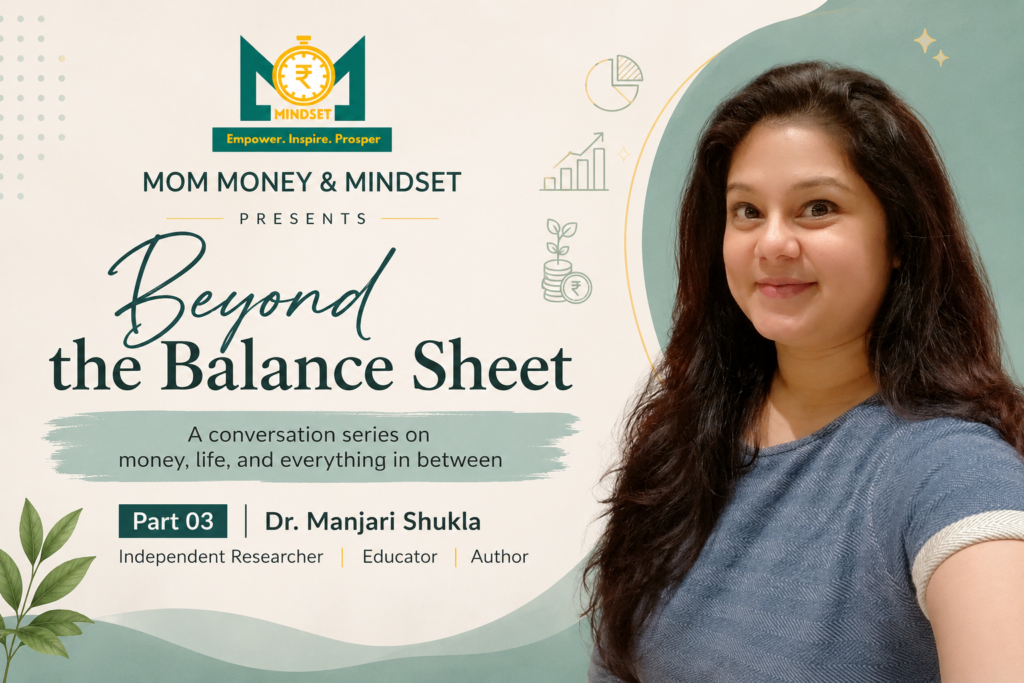
THIS EPISODE’S GUEST
Dr. Manjari Shukla
Independent Researcher | Educator | Author | Former Asst. Professor, Vasanta College for Women, Varanasi
Dr. Manjari Shukla has spent over 14 years teaching young women from diverse social and economic backgrounds across India. Her academic specialisation is postcolonial women’s writing — a field that places women’s voices, agency, and struggle for self-determination at the centre of literary inquiry. She has presented at over 30 national and international conferences, and her scholarly work has been published in peer-reviewed journals.
She currently runs a YouTube channel and an Instagram page, sharing her insights on books, mindfulness, spirituality, and literature, and is working on several child-friendly projects.
“When education nurtures both knowledge and financial wisdom, it empowers women not just to earn a livelihood but to lead lives of purpose, resilience, and informed choice.”
Q1. You have spent over 14 years teaching young women and have closely studied women’s voices through literature and postcolonial women’s writing. In your experience, how does financial independence influence a woman’s ability to make choices, express her voice, and challenge the social expectations placed upon her? Do you believe our education system is doing enough to prepare young women for financial independence?
Dr. Manjari Shukla:
For me, financial independence is not merely about earning an income; it is about having the freedom to make choices with dignity, confidence, and self-respect.
Throughout my years as an educator, I have taught hundreds of young women from diverse social and economic backgrounds. While each of them carried unique dreams and aspirations, one common thread stood out: the ability to make independent decisions was often closely linked to financial awareness and economic security.
My academic work on postcolonial women’s writing has further reinforced this understanding. Literature repeatedly shows us that women find their voice not only through education but also through the ability to exercise agency. Financial independence strengthens that agency. It enables women to participate in family decisions, pursue higher education, choose careers aligned with their aspirations, and, when necessary, walk away from circumstances that compromise their dignity or well-being. It transforms confidence from an internal feeling into a lived reality.
However, I believe financial independence should be accompanied by financial literacy. Earning money and managing money are two very different skills. Many highly educated women are successful professionals, yet they hesitate when it comes to investments, taxation, insurance, retirement planning, or wealth creation because these conversations were never part of their upbringing or formal education.
This is where our education system still has considerable ground to cover. We continue to prepare students to qualify for jobs, but we rarely prepare them to manage life. Financial literacy should not remain an optional workshop or an occasional seminar; it deserves a meaningful place within mainstream education. Young people — especially girls — should graduate with practical knowledge of budgeting, saving, investing, responsible borrowing, digital finance, and long-term financial planning.
When education nurtures both knowledge and financial wisdom, it empowers women not just to earn a livelihood but to lead lives of purpose, resilience, and informed choice.
PRERNA’S LENS →
There is a phrase in Dr. Manjari’s answer that I keep returning to: financial independence transforms confidence from an internal feeling into a lived reality. This is one of the most precise descriptions of what I try to build in the women I work with. Confidence that you cannot spend, or save, or act upon — confidence that exists only inside you — is fragile. It depends on external validation to survive. Financial confidence is different: it is structural, portable, and self-reinforcing.
What Dr. Manjari is also naming — through 14 years of teaching — is the gap between qualification and capability. India produces millions of highly educated women every year. And a significant number of them arrive at financial decisions — a mutual fund choice, an insurance policy, a negotiation over salary — without the vocabulary or the practice to navigate them. Not because they are not intelligent. Because nobody thought to teach them.
This connects directly to what Nidhi Vadhera told us in Episode 1: the guardian mindset and the wealth creator mindset are not the same thing. Education has been preparing women to earn. It has not been preparing them to grow what they earn. Dr. Manjari is saying the same thing from the classroom side of the same wall.
“Financial independence enables women to walk away from circumstances that compromise their dignity or well-being. It transforms confidence from an internal feeling into a lived reality.” — Dr. Manjari Shukla
Q2. Children learn many of their earliest beliefs about money, ambition, gender roles, and success from the stories they read and the conversations they witness at home and in school. As an educator and someone who is currently working on children’s books, how can literature and storytelling be used to introduce financial literacy, equality, and economic agency to children without taking away the imagination and joy of childhood?
Dr. Manjari Shukla:
Children understand the world through stories long before they understand definitions. Stories shape their imagination, values, and sense of possibility. This is precisely why literature has such extraordinary power — it teaches without preaching.
As someone who teaches literature and is currently working on children’s books, I believe financial literacy for children should never begin with concepts like profit, investment, or wealth. It should begin with values such as responsibility, patience, gratitude, kindness, sharing, thoughtful decision-making, and understanding the difference between needs and wants. These are the emotional foundations upon which sound financial habits are eventually built.
A well-crafted story can gently introduce these ideas through relatable characters and everyday experiences. A child who saves to buy a book, friends who collaborate to solve a problem, siblings who learn the value of sharing resources, or a family that makes thoughtful choices together — these narratives can naturally spark conversations about money without making the story feel instructional. When financial concepts are woven into meaningful stories, children absorb them almost effortlessly.
Equally important is the way stories portray gender. Children should grow up reading narratives where girls and boys are equally curious, capable, compassionate, and responsible. They should encounter women who are scientists, artists, entrepreneurs, teachers, and financial decision-makers, just as naturally as they encounter nurturing fathers or emotionally expressive boys. Such representation quietly broadens their understanding of what is possible.
At the same time, we must preserve the wonder of childhood. Financial literacy should never replace imagination; rather, it should complement it. Fairy tales, adventures, fantasy, humour, and play remain essential because imagination itself nurtures creativity, problem-solving, and resilience — qualities that are invaluable throughout life.
Ultimately, the goal is not to raise children who merely know how to earn money but children who grow into thoughtful, empathetic, and financially responsible adults. Stories have always shaped societies, and I believe they can also help shape a generation that values equality, wisdom, generosity, and informed financial choices.
PRERNA’S LENS →
This answer matters enormously to me — particularly the distinction between beginning with values and beginning with vocabulary. In my work with parents and children, I have seen what happens when you try to start with the concept rather than the feeling. Children switch off. The lesson becomes another thing an adult is trying to teach them.
But a child who reads a story about saving for something they want — not told that saving is important, but shown what it feels like to wait and then hold the thing you waited for — that child has received the lesson at an emotional level. It lands differently. It lasts longer.
Dr. Manjari’s point about gender representation in stories is not incidental. It is foundational. The child who grows up reading stories where financial decisions are always made by men — where mothers ask for money and fathers provide it — is absorbing a financial curriculum from those stories whether anyone intends it or not. Changing the stories changes the curriculum. This is perhaps the quietest and most powerful argument for why children’s literature and financial literacy belong in the same conversation.
As someone developing financial literacy books for Classes 6, 7, and 8, I feel the weight of this responsibility personally. The characters in those books are not just vehicles for information. They are models of what is possible. That is a design decision as much as an editorial one.
“Financial literacy for children should never begin with concepts like profit or investment. It should begin with values — responsibility, patience, gratitude, and the difference between needs and wants. These are the emotional foundations upon which sound financial habits are eventually built.”
— Dr. Manjari Shukla
Q3. We often speak about women’s empowerment through education and employment, but financial literacy and financial decision-making are still missing from many conversations. From your experience of working with generations of young women, what mindset barriers continue to prevent educated women from taking ownership of their finances, and what changes would you like to see in families, classrooms, and society to raise a generation of financially confident women and children?
Dr. Manjari Shukla:
One of the most striking observations from my years of teaching is that education alone does not automatically translate into financial confidence. I have met brilliant young women who excel academically, pursue meaningful careers, and demonstrate remarkable leadership — yet hesitate when it comes to making financial decisions. The barrier is rarely a lack of intelligence; more often, it is a mindset shaped by years of subtle social conditioning.
Many girls grow up hearing conversations about spending but not about investing. They are encouraged to achieve academically but are seldom invited into discussions about household budgeting, taxation, insurance, long-term savings, or wealth creation. Financial decision-making is still, in many families, viewed as someone else’s responsibility. Over time, this creates hesitation rather than capability.
Another significant barrier is the misconception that discussing money is somehow uncomfortable or inappropriate. We speak openly about education, careers, and achievements, yet conversations about personal finance often remain surrounded by silence. This silence can become a barrier that prevents even educated women from asking questions or building financial confidence.
I believe the change must begin at multiple levels. Families should involve children — both daughters and sons — in age-appropriate discussions about budgeting, saving, charitable giving, and responsible financial choices. Schools should integrate financial literacy into everyday learning through practical, activity-based experiences rather than treating it as an isolated subject. Colleges and universities can equip young adults with essential life skills such as investment planning, taxation, digital financial safety, and retirement planning.
Most importantly, we need to redefine financial literacy as a life skill rather than a specialised field reserved for experts. Every individual, regardless of profession, deserves the confidence to understand and manage personal finances.
True empowerment lies in enabling individuals to think independently, make informed choices, and contribute meaningfully to society. Financial confidence is a natural extension of that philosophy.
PRERNA’S LENS →
The phrase Dr. Manjari uses — “this silence can become a barrier” — is one I have watched play out in real time, in workshops with women who are doctors, lawyers, engineers, and professors, and who lower their voices when asked about their own investment portfolio. Not because they are ashamed. Because they were never taught that this was a conversation they were allowed to enter.
The silence around money in many Indian households is not accidental. It is the product of a long, quiet cultural curriculum that assigned financial decision-making to one gender and financial anxiety to another. Changing this requires exactly what Dr. Manjari describes: a multi-level intervention. Not just school curricula. Not just workshops. But the daily, unremarkable decision at the dinner table to include a daughter in the conversation about where this month’s money goes.
I think about our Women’s Day piece this year — the data showing that 89% of married Indian women depend entirely on their spouses for financial planning. Dr. Manjari’s classroom gives those statistics a face: they are the brilliant students she has taught for 14 years, arriving capable and leaving hesitant — not because education failed them, but because financial education was never part of what education meant.
“The barrier is rarely a lack of intelligence. More often, it is a mindset shaped by years of subtle social conditioning — girls who grew up hearing conversations about spending but never about investing.”
— Dr. Manjari Shukla
A Final Thought — From Prerna
Three episodes into Beyond the Balance Sheet, a pattern is forming that I did not entirely anticipate when we began.
Nidhi Vadhera told us to move from guardian to creator. Dr. Gaurav Mukhija showed us that financial stress arrives in the paediatric clinic before it ever arrives in the bank statement. And now Dr. Manjari Shukla is telling us that the story we tell a child — in a book, at bedtime, in the way we speak about money at home — is the first financial education they will ever receive. It arrives before any curriculum, before any workshop, before any formal lesson.
What unites all three guests is the conviction that financial literacy is not a subject. It is a culture. A set of habits, conversations, stories, and permissions that accumulate over a lifetime — and that either build financial confidence or quietly undermine it.
Dr. Manjari works with the power of narrative. I work on a money mindset. The more conversations like this one I have, the more clearly I see that these are not different endeavours. They are the same endeavour, approached from different rooms.
The room that changes everything — as every guest in this series has said, in their own way — is the one you already live in. 💜
— Prerna Rohilla & Dr. Manjari Shukla
Financial wisdom begins with conversation.
Bring that conversation to your family, school, or organisation.
Mom Money & Mindset offers workshops and sessions for families, schools, colleges, and corporates on financial literacy, money mindset, and raising financially confident children and women.
👉 Connect with us at mommoneyandmindset.com/contact/
ALSO IN BEYOND THE BALANCE SHEET:
- Episode 01 | “Be a Wealth Creator, Not Just a Guardian” — Nidhi Vadhera
- Episode 02 | “The Question a Child Asked His Paediatrician” — Dr. Gaurav Mukhija
This conversation was conducted in written format in July 2026 and has been lightly edited for clarity and flow. Views expressed are Dr. Manjari Shukla’s own. Dr. Shukla is an Independent Researcher and Educator, and former Assistant Professor at Vasanta College for Women, Varanasi.
Thank you for providing me with the opportunity to share my insights on your platform. In today’s world, financialsho literacy is an essential life skill, especially for the younger generation. Your efforts to spread awareness and foster meaningful conversations around this subject are truly commendable. Wishing you continued success and my best wishes for all your upcoming ventures.
We are glad you became a part of this. Thank you for your valuable insights.
Pingback: “The Real Examination Begins After School Ends” | Beyond the Balance Sheet – Mom Money Mindset