
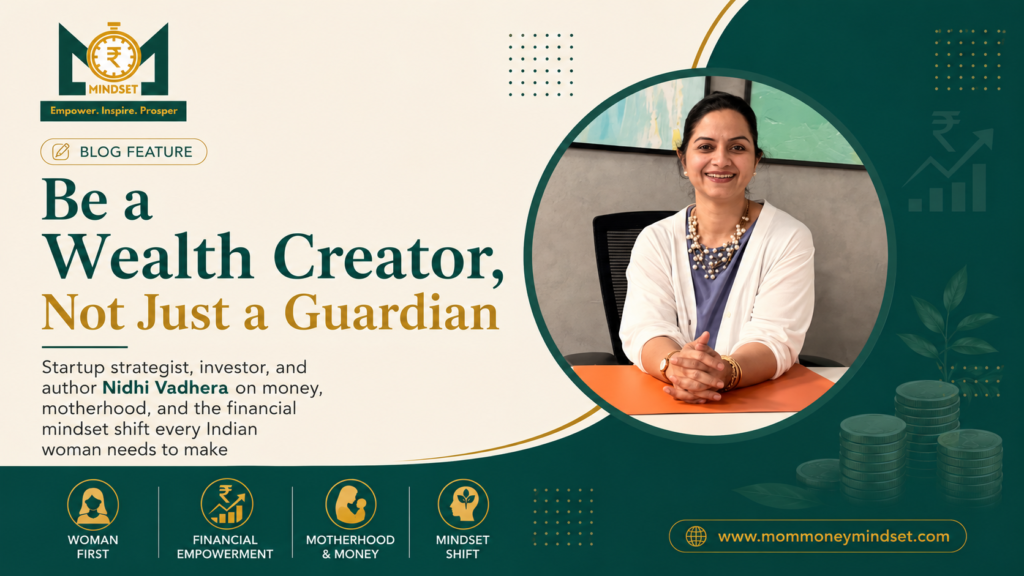
Startup strategist, investor, and author Nidhi Vadhera on money, motherhood, and the financial mindset shift every Indian woman needs to make.
Every woman who has built something — a business, a career, a financial life from scratch — carries within her story the seeds of lessons she never formally received. The financial education that made her who she is usually came not from a classroom or a textbook but from observation, trial, the occasional expensive mistake, and the slow accumulation of experience.
Nidhi Vadhera is that kind of woman.
A conversation that covered childhood, entrepreneurship, daughters, and the urgent gaps in how India teaches money, what emerged was not a lecture on financial planning but something rarer: an honest account of how one woman’s relationship with money evolved — and what she believes every woman in India needs to hear right now.
Nidhi speaks with the particular clarity of someone who has sat on both sides of the money table — as an employee who managed other people’s money at CitiFinancial, as an entrepreneur who had to learn risk the hard way, and as a mother who is now consciously writing a different financial story for her daughter than the one she inherited.
| FEATURED VOICE Nidhi Vadhera Startup Strategist | Investor | Author | Co-Founder & COO, StartupConnect Global Nidhi Vadhera is one of India’s most distinctive voices at the intersection of entrepreneurship, sales leadership, and women’s empowerment. With over two decades spanning banking (CitiFinancial), global startup ecosystems (StartupConnect Global), and entrepreneurship (Vertical Hyphen, Spark GlobalX), she has enabled 40+ startups, facilitated $25M+ in investments, and built 50+ cross-border partnerships across India, Singapore, Japan, and Australia. She is also India’s first woman author on sales—her book Romancing Targets reframes how professionals approach targets, performance, and the psychology of selling. Published by Business Standard as ‘a must for anyone in sales. Nidhi speaks to us not as a theorist on women’s financial empowerment but as a practitioner—someone who has lived the journey from employed professional to entrepreneur to investor and has watched how money shapes every transition along the way. |
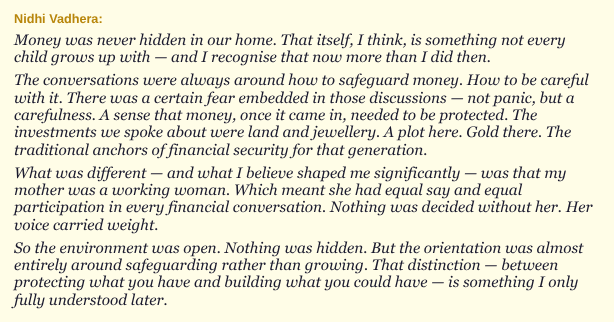
Q1. What did conversations around money look like in your household during your childhood?
PRERNA’S LENS →
What Nidhi is describing is the money environment that shaped the financial psychology of an entire generation of Indian women. A household where money was discussed but fear-adjacent. Where security meant gold and land. Where a working mother’s voice was present, but the vocabulary was still conservative.
The openness itself was a gift — many women grew up in homes where money was either invisible or explosive. But the orientation toward safeguarding over growing planted a seed that took Nidhi years of entrepreneurship to uproot. It is a pattern we see repeatedly: financially aware households that still pass on scarcity-adjacent thinking, simply because nobody taught them the language of abundance.
As we explored in our article on money mindset this year, the stories we inherit about money operate silently for decades. Recognising them is the first act of financial liberation.
“My mother was a working woman — which meant she had equal say in every financial conversation. Nothing was decided without her. That shaped me significantly.”— Nidhi Vadhera
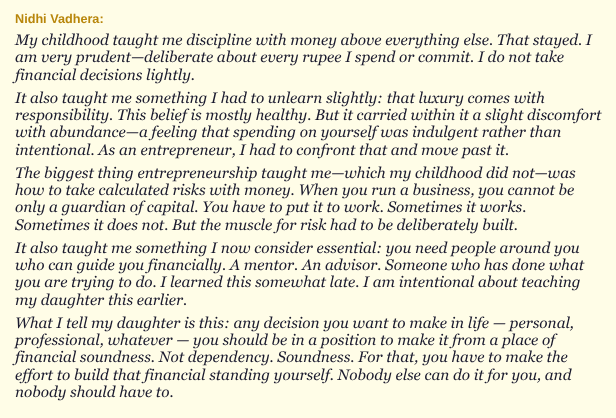
Q2. How did that early environment shape your financial habits, and what lessons are you now intentional about teaching your daughter?
PRERNA’S LENS →
There are several layers in what Nidhi has just said, and each one is worth sitting with.
The first is the inheritance paradox — she received discipline and prudence from her parents, and these are genuine assets. But the same environment that gave her discipline also gave her a slight discomfort with abundance. This is not unusual. Many of the most financially cautious women I work with carry exactly this: they are excellent at not losing money and less confident at growing it.
The second is entrepreneurship as financial education. The classroom did not teach Nidhi risk. Life did. This is precisely why we argue, loudly and consistently, that financial literacy cannot be left to circumstance. By the time most women get the real financial education — through business, through marriage, through crisis — they have already paid an unnecessary tuition.
The third is the lesson she is passing to her daughter, and it is the most important one: build your own financial soundness. Not because you distrust others, but because your own financial standing is what makes every other decision in your life genuinely free.
“Any decision you want to make in life—personal, professional, whatever—you should be in a position to make it from a place of financial soundness. Not dependency. Soundness.”—Nidhi Vadhera
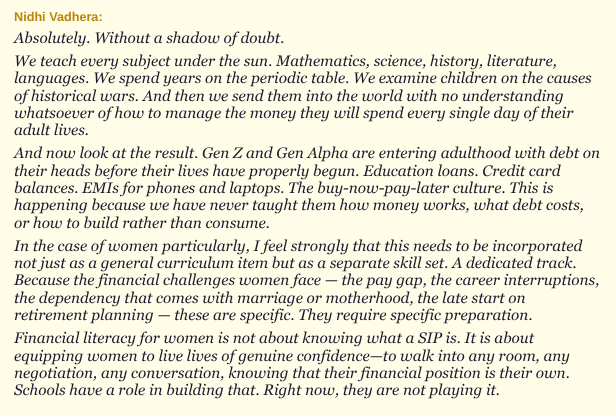
Q3: Do you think financial literacy needs to be integrated into the core curriculum as a mandatory life skill?
PRERNA’S LENS →
Nidhi is articulating something our education system has been slow to confront — and which the NEET crisis, the CBSE pressure, and the broader conversation about rote learning versus skills have made impossible to ignore in 2026.
We recently wrote about exactly this — the gap between what India’s education system teaches and what the world actually requires. Financial literacy did not make it into NEP 2020 as a mandatory subject. No major Indian board exam tests it. And yet the cost of that gap — in personal debt, in financial anxiety, in women who reach their forties without ever having made an independent financial decision — is enormous and compounding.
Nidhi’s point about women specifically is particularly sharp. The financial curriculum that might work for a 22-year-old man entering his first job is not the same curriculum a woman needs — one who may take a career break, who may navigate the financial dynamics of a joint family, who faces a different set of pressures around money and independence. Designing financial education without accounting for this is designing it for only half the population.
“Gen Z and Gen Alpha are entering adulthood with debt on their heads before their lives have properly begun. This is happening because we have never taught them how money works.”— Nidhi Vadhera
Q4: As an entrepreneur/mentor, what is the single most important money mindset shift you believe every woman should make?

PRERNA’S LENS →
This is the sentence I want every woman reading this to write down and keep somewhere she will see it: be a wealth creator, not just a guardian. I have worked with hundreds of women on their financial journeys, and the guardian versus creator distinction is one of the most accurate ways I have found to describe where most women sit—and where they need to move. Women are extraordinary managers of money that already exists. They track. They budget. They protect. The gap is in making money move—in putting it to work, in taking the calculated risk, and in making the investment decision without waiting for someone else to validate it. What Nidhi is describing is not recklessness. It is an agency. The belief that your financial decisions are yours to make—with information, with support, with community, but ultimately, yours. And that belief is not inherited. It is built. Which is exactly why the spaces where women can learn, practice, and build that muscle — together, without judgment, with the right guidance — are not luxuries. They are necessities.
“Be a money earner and a wealth creator. A woman who owns her financial decisions owns her life.” — Nidhi Vadhera
The Four Takeaways From This Conversation
Across four questions and a single phone call, Nidhi Vadhera covered the full arc of a woman’s financial life — from childhood inheritance to adult practice to what she is consciously passing on to the next generation. Here is what we are carrying forward:
| 1. Open money conversations are a gift — but orientation matters. Nidhi grew up in a household that talked about money openly. This gave her discipline and awareness. But the conversation was oriented toward safeguarding, not growing. Both are needed. If your home talks about money only in terms of what could go wrong, consider adding the conversation about what could go right. |
| 2. Risk is a muscle that must be deliberately built. Nidhi’s financial confidence expanded significantly when she became an entrepreneur — because entrepreneurship forced her to take calculated risks with money. Most women do not get this education through circumstance. It must be sought intentionally. Through small investments, financial decisions made independently, and mentors who can guide without deciding for you. |
| 3. Financial literacy for women is a specific, urgent curriculum gap. The generic financial literacy conversation does not account for the particular financial realities of Indian women—career interruptions, joint family dynamics, and the dependency that can follow marriage or motherhood. Designing financial education that speaks directly to women is not a niche concern. It is the mainstream one. |
| 4. Move from guardian to wealth creator. The single most important shift. Not abandoning discipline or prudence — but expanding beyond it. Making your money work. Trusting your own financial instincts. Refusing to outsource decisions that are fundamentally yours to make. Be a money earner. Be a wealth creator. These are not two separate goals. They are one. |
A Note From Prerna
Speaking with Nidhi reminded me, again, of something I believe deeply: the women who have built financial confidence and independence did not receive it as a gift. They built it — through experience, through setback, through the courage to make decisions others might have made for them.
What we are doing at Mom Money & Mindset is trying to shorten that journey. To give women — and their children — the vocabulary, the tools, and the community to build financial confidence without having to wait for a crisis or a career pivot to deliver the lesson.
Nidhi’s story is powerful. But your daughter does not need to spend twenty years in the workforce before she understands that she is a wealth creator. She can learn it now. So can you. 💜
About Nidhi Vadhera
Nidhi Vadhera is Co-Founder & COO of StartupConnect Global, Founder of Vertical Hyphen (branding & communications), and Co-Founder of Spark GlobalX (global business expansion). She holds a PGDBM from NMIMS and has previously held leadership roles at CitiFinancial Consumer Finance India, EHP International, and Venus Academy. She is the author of Romancing Targets — India’s first book on sales by a woman author. This conversation was conducted telephonically in June 2026 and has been lightly edited for clarity and flow. Views expressed are Nidhi Vadhera’s own. | nidhivadhera.com
Great content! Keep up the good work!
Thank you!
Pingback: “Financial Confidence Is a Natural Extension of True Empowerment” | Beyond the Balance Sheet – Mom Money Mindset
Pingback: “The Real Examination Begins After School Ends” | Beyond the Balance Sheet – Mom Money Mindset