
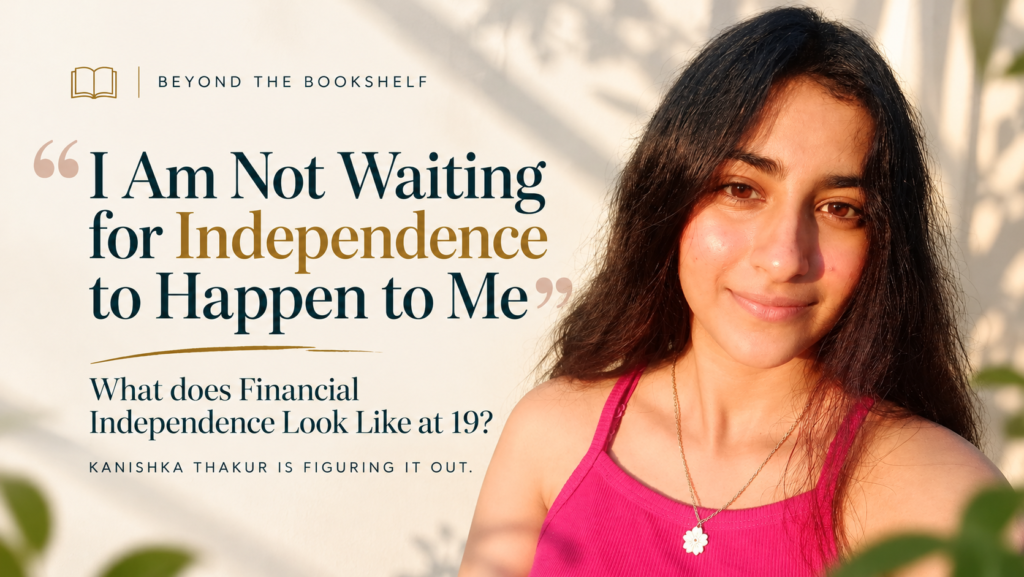
What happens when a teenager decides that she wants to earn her own money?
For Kanishka Thakur, it started with something as simple as writing.
She began writing in Class 9. What started as a skill she was developing at a young age eventually became the foundation for her freelancing journey. Today, Kanishka is a second-year college student working with clients outside India while balancing her academics and her growing professional life.
Her journey isn’t conventional.
But perhaps, neither is the way she thinks about work, money or independence.
For Kanishka, the motivation to work comes from one clear goal: she wants to become financially independent.
That desire has pushed her to explore more, learn more and keep working even when the journey hasn’t always been easy.
Because for her, freelancing isn’t just about getting paid.
It is about building something of her own.
THIS EPISODE’S GUEST
Kanishka Thakur is a second-year college student, writer and freelancer who started writing in Class 9.
Over the years, she turned that early interest into a professional skill and eventually began freelancing. Today, she works with clients outside India while continuing her college education.
Her story is a reminder that the journey towards financial independence doesn’t necessarily begin with a full-time job.
Sometimes, it begins with a skill.
And sometimes, it begins with the decision to take that skill seriously.
A FAMILY WHERE NOTHING IS “CONVENTIONAL”
Perhaps one of the most interesting parts of Kanishka’s story is not her freelancing journey at all.
It is her family.
When asked about whether anything in her family follows conventional roles, Kanishka’s answer was clear: nothing really is conventional.
Her father is a homemaker.
Her mother works.
Her sisters work too.
Growing up in a household where these roles exist differently from traditional expectations has given Kanishka a different perspective on work and independence.
There isn’t one fixed definition of who earns and who takes care of the home.
Everyone has their own role.
And perhaps that has also made it easier for Kanishka to imagine a path of her own.
Her story doesn’t follow the traditional sequence of school, college, graduation and then work.
She started building a professional skill much earlier.
By college, she was already using that skill to work with clients. And now, she is figuring out how to build something sustainable around it.
FROM CLASS 9 TO INTERNATIONAL CLIENTS
Kanishka started writing in Class 9.
That is unusually early when we think about professional journeys.
Most students don’t begin thinking seriously about earning until they are in college or approaching graduation. Kanishka, however, had already begun developing a skill years before that.
Writing became something she could eventually offer professionally.
Freelancing then gave her a way to turn that skill into an income.
Today, she works with clients outside India.
Of course, getting to this point came with its own learning curve.
Freelancing means understanding clients, managing deadlines, communicating professionally and constantly improving the quality of your work.
It also means learning things that aren’t always taught in classrooms.
How do you find opportunities?
How do you work with clients?
How do you handle responsibility?
How do you value your own work?
And how do you keep learning when you are still figuring everything out yourself?
Kanishka’s journey has involved all of these lessons.
But instead of seeing the challenges as reasons to stop, she has continued moving forward.
That determination is central to her story.
THE POWER OF WANTING TO BE FINANCIALLY INDEPENDENT
For Kanishka, the strongest motivation behind her work is simple: she wants to become financially independent.
It is this goal that drives her to work more and learn more.
Financial independence can mean different things to different people.
For some, it means paying their own bills.
For others, it means supporting their family or having the freedom to make decisions without depending financially on someone else.
For Kanishka, it is about creating that sense of independence for herself.
And there is something powerful about having a financial goal that is personal.
It gives meaning to the work beyond the immediate paycheck.
A project becomes more than a project.
A client becomes more than a client.
Each opportunity becomes another step towards a larger goal.
PRERNA’S LENS
We often talk about financial independence as something that comes much later in life.
A stable career.
A substantial income.
Savings.
Investments.
A financial plan.
But Kanishka’s story makes us look at it differently.
Financial independence can begin much earlier.
It can begin with a young person deciding that they want to build a skill.
It can begin with their first client.
Their first payment.
Their first attempt at managing their own money.
The amount may be small in the beginning.
The experience may be limited.
But the mindset can already be there.
And sometimes, that mindset is the most important starting point.
TWO BANK ACCOUNTS AND A BIGGER LESSON
Kanishka has already taken one small but meaningful step towards managing her finances.
She maintains two separate bank accounts—one for her income and another for spending.
On the surface, it may seem like a simple organisational choice.
But separating money based on its purpose can create an important financial habit.
It allows you to distinguish between what you earn and what you spend.
This is my income.
This is what I can spend.
As income grows, that distinction can become increasingly valuable.
But Kanishka also recognises that she still has a lot to learn about managing her finances.
And perhaps that honesty is just as important as the two bank accounts.
Because earning money and understanding money are two different skills.
You can learn how to find clients without knowing how much you should save.
You can receive your first freelance payment without knowing how to budget it.
You can start earning independently while still learning about saving, investing and financial planning.
There is nothing unusual about that.
Financial literacy is a journey too.
PRERNA’S LENS
We often tell young people to start earning.
But perhaps the next question should be:
What are you doing with what you earn?
The first step towards financial independence may be earning.
The next is learning how to manage that income.
Kanishka has already started creating that distinction through her two accounts. Her next chapter can be about understanding what happens to the money after it enters those accounts.
Because financial independence isn’t just about how much you earn.
It is also about how confidently you can manage what you earn.
LEARNING WHILE DOING
Starting early doesn’t mean having everything figured out.
In fact, it can mean the opposite.
You are learning as you go.
Every client teaches you something.
Every project tells you something about your strengths.
Every mistake becomes feedback.
And every successful project builds confidence.
Kanishka’s freelancing journey has come with its own lessons, but she remains determined to make it work.
She isn’t waiting until college is over.
She isn’t waiting until she knows everything about freelancing.
She is learning while doing.
And that might be one of the most valuable lessons for other young people considering a similar path.
You don’t need to know everything before you begin.
You need to be willing to learn once you do.
WHAT DOES FINANCIAL INDEPENDENCE LOOK LIKE IN COLLEGE?
For a second-year college student, financial independence doesn’t necessarily mean paying every household bill or having a large income.
It can start much smaller.
It can mean earning your first income.
Knowing where it goes.
Saving a portion of it.
Learning how banking works.
Understanding your spending habits.
And gradually becoming more confident with financial decisions.
Kanishka is still at the beginning of this journey.
She is still learning about money.
She is still developing her freelancing career.
But she has already done something important: she has started.
And perhaps that is what makes her story so encouraging.
She doesn’t claim to have mastered money.
She simply knows that she wants to become better at it.
A FINAL THOUGHT — FROM PRERNA
Kanishka’s story isn’t about having everything figured out.
It is about starting early and being willing to keep learning.
She started writing in Class 9.
Today, she is a college student working with clients outside India.
She has created an income stream for herself, while still learning how to manage that income better.
She has two bank accounts, but knows there is much more she wants to understand about money.
And she has one goal that continues to push her forward: financial independence.
What makes her journey particularly interesting is that she isn’t coming from a conventional definition of what work or family should look like.
Her father is a homemaker.
Her mother works.
Her sisters work.
And now, Kanishka is building her own professional path too.
Perhaps independence doesn’t always have to look the same.
Sometimes, it looks like a career.
Sometimes, it looks like a business.
Sometimes, it looks like freelancing from a college laptop while figuring things out along the way.
And sometimes, it simply looks like a young person saying:
I want to earn. I want to learn. And I want to be financially independent.
Kanishka is still at the beginning of her journey.
But she isn’t waiting for independence to happen to her.
She is building it herself.
She is not waiting for independence to happen to her. Are you?
👉 Connect with us at mommoneyandmindset.com/contact/
Mom Money & Mindset works with young people, families, and schools across India on the money skills, mindset, and habits that make financial independence real — not eventual.