
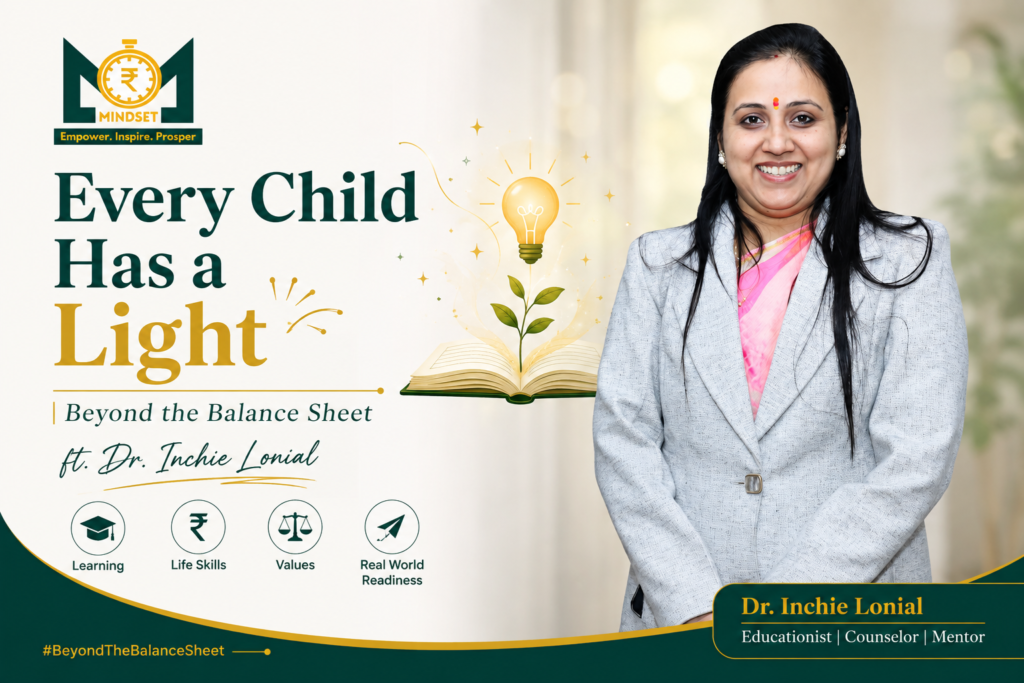
Every conversation in this series has arrived from a different room. A startup’s boardroom. A literature classroom. A school’s academic office. A paediatric clinic where children’s financial stress shows up before it ever shows up in a bank statement.
This episode comes from the most intimate room of all.
The therapy mat. The NICU corridor. The counselling session where a parent has just received a diagnosis that changes everything they thought they knew about their child’s future — and, without anyone explicitly saying so, about their family’s finances too.
Dr. Inchie Lonial has spent 21+ years in that room. As a Senior Pediatric Physiotherapist, Special Educator, Certified Autism Specialist, storyteller, and author, she has walked alongside thousands of families in Meerut and across North India navigating the intersection of disability, love, and money. She founded Sarthak Enkindling Hopes in 2006 — one of the oldest and most trusted paediatric therapy centres in the region — at a time when, as she says, there was no one to guide parents in this part of the country.
In 21 years, she has observed something that most financial educators never see: what happens to a family’s money when the diagnosis arrives. The exhaustion of early years spent travelling from city to city for therapies. The savings quietly emptied. The future — both the child’s and the siblings’—is suddenly uncertain. And the almost complete absence of anyone helping these parents think financially, not just clinically.
This episode is different from the others. It is quieter. It is heavier. And it is one of the most important conversations this series has had.
TODAY’S GUEST
Dr. Inchie Lonial (PT)
Senior Pediatric Physiotherapist | Special Educator | Certified Autism Specialist | Storyteller & Author | Founder, Sarthak Enkindling Hopes, Meerut
Dr. Inchie Lonial holds a Masters in Physiotherapy (Neurology) and carries certifications in Early Intervention, Special Education (RCI), Applied Behaviour Analysis, Brain Gym, Music Therapy (Nada, Chennai), Dyslexia, Autism, and Storytelling (Kathalaya). She is a DMI Registered Practitioner — the first to bring Dynamic Movement Intervention to Meerut and Western UP. Her centre, Sarthak Enkindling Hopes, established in 2006, has served families navigating Cerebral Palsy, Autism Spectrum Disorder, ADHD, Intellectual Disability, Genetic Syndromes, Dyslexia, Dysgraphia, and Dyspraxia across Meerut, North India, and through telerehabilitation, globally.
She received the Significant Contribution Award from the Indian Association of Physiotherapists in 2015.
She is also the author of Light Beyond the Bubble and Little Lives, Mighty Miracles — books born from two decades of living alongside families whose stories, she felt, needed to be shared with the world. Through her parallel initiative, Amaya’s StoryLand, she uses sensory storytelling as a therapeutic and educational tool for children with special needs and learning disabilities.
“Every child has a rhythm. Every child has a light. And as long as I am able, I will keep showing up on the floor and on our mats to make sure that light shines through.”
Q1. In your 21+ years of working with families of children with special needs, what does the financial and emotional burden look like — and what kind of guidance do these parents most urgently need?
Dr. Inchie Lonial (PT):
In my 21+ years of practising in Meerut and across North India — from a time when there was no one to guide parents in this region — I’ve walked alongside thousands of families. Whether a child is navigating Cerebral Palsy, Autism, ADHD, Intellectual Impairment, Genetic Syndromes, or Specific Learning Disorders like Dyslexia, Dysgraphia, and Dyspraxia, the story almost always begins with a storm.
For many, that storm starts right at the beginning — with a traumatic Neonatal ICU stay, post-birth asphyxia, or early red flags of Developmental Delay. In our Indian culture, the child is the absolute pivot around which every family decision, dream, and rupee revolves.
Parents naturally go into overdrive with a mindset of “whatever it takes.” But therapy is a marathon, not a sprint. Families often exhaust all their life savings in the initial years, travelling from city to city for therapies, leaving themselves financially depleted for the long haul. Parents desperately need counselling on how to decide how much to spend versus how much to save. A balanced budget is part of therapy.
For children with severe cognitive impairments or Autism who cannot manage finances independently, verbal promises within extended families simply do not work. Parents need concrete guidance on creating a Will and setting up a Special Needs Trust — ensuring their child’s share of the family legacy is legally airtight, protected from exploitation, and strictly earmarked for their lifelong care, medical needs, and dignity. Whether the child is a boy or a girl, this protection must be equal.
And then there is the emotional divide. The mother lives the moment-to-moment reality — executing home plans, managing sensory meltdowns, and handling heavy physical caregiving. This chronic caregiving stress is a real clinical entity. Caregiver survival is not a luxury; if the mother burns out, the home structure collapses. The father carries the silent weight of the future: “Who will protect my child when I am gone?” Quality of life for the entire family must be an essential priority. Maintaining the parents’ mental, physical, and financial health is directly linked to the child’s long-term happiness and survival.
PRERNA’S LENS →
The sentence that stopped me completely was this one: A balanced budget is part of therapy. In five words, Dr. Inchie has named something that the financial world and the medical world have both failed to say loudly enough. The financial sustainability of a family is not separate from a child’s therapeutic outcomes. It is inseparable from them. A family that has exhausted its savings in year two has no resources for year five, year ten, or year twenty — the years that may matter most.
What Dr. Inchie is describing is also one of the most invisible caregiving realities in India. The mother who is managing a child’s sensory meltdowns, implementing home therapy plans, and keeping the entire ecosystem running — while simultaneously absorbing the financial anxiety of a depleting savings account — is carrying a load that our systems were not built to acknowledge, let alone support. The burnout she describes is not a personal failure. It is a systemic one.
The call for Special Needs Trusts and legally structured Wills is one I want every parent reading this to sit with — not just parents of children with disabilities, but every parent. The question “Who will protect my child when I am gone?” is one that every father and mother carries. The difference, for the families Dr. Inchie works with, is that the answer is more urgent, more complex, and more financially consequential than most. And in India, where family verbal promises are culturally powerful but legally weightless, the gap between intention and protection can be devastating.
“Parents desperately need counselling on how to decide how much to spend versus how much to save. A balanced budget is part of therapy.”
— Dr. Inchie Lonial (PT)
Q2. When a home revolves around a child with special needs, what happens to the other children — and what does society need to understand and do differently?
Dr. Inchie Lonial (PT):
When a home revolves around a child with special needs, the neurotypical sibling often becomes the “invisible caregiver.” Balancing the emotional and financial ecosystem for all children in the family is vital for long-term family viability.
We must never raise neurotypical siblings with the heavy, unspoken assumption that they are solely responsible for their brother or sister’s future. They must be sensitised with love, but they must also feel that their own dreams, careers, and financial shares are equally valued and protected.
When parents create a structured Will and Trust, it removes a massive emotional weight from the neurotypical sibling — allowing them to offer lifelong love out of choice and bond, rather than financial panic. Moreover, it ensures the child with neurodivergence is fully protected, with zero ambiguity about how their share will be utilised.
Society also needs to stop offering intrusive sympathy or unsolicited advice. What parents in tier-2 cities like Meerut actually need is community acceptance, inclusive spaces, and practical help so caregivers can recharge. The shift we need is from pity to practical support — from asking “why did this happen?” to asking “what do you need today?”
PRERNA’S LENS →
The invisible caregiver. I had not heard it named that way before, and I find it one of the most precise descriptions of what happens in these families. The sibling who quietly learns to need less, ask for less, expect less — because they can see, every day, that the family’s resources of attention, energy, and money are being justifiably directed elsewhere. The love is real. But so is the cost.
Dr. Inchie’s point about structured financial planning as an act of love for the neurotypical sibling is something I want to highlight. A Will and Trust for a child with special needs is not just about protecting that child. It is about releasing the sibling from a burden they should never have been asked to carry alone — allowing them to love freely, rather than from obligation born of fear.
The call for society to shift from pity to practical support resonates deeply with me — and connects to something I see repeatedly in my work with women and families. We are very good at expressing sympathy in India. We are far less practised at offering the kind of quiet, non-intrusive, sustained practical support that actually makes a difference to a caregiver’s daily life. Community acceptance, inclusive spaces, and the permission for a parent to step away for an hour without guilt — these are not luxuries. They are the infrastructure of survival.
“We must never raise neurotypical siblings with the heavy, unspoken assumption that they are solely responsible for their brother or sister’s future. Their own dreams, careers, and financial shares must be equally valued.”
— Dr. Inchie Lonial (PT)
Q3. After 21+ years of this work, what keeps you going — and what have these families taught you about what really matters?
Dr. Inchie Lonial (PT):
When I started two decades ago, families in this region walked in filled with isolation, guilt, and fear after difficult post-NICU discharges or devastating new diagnoses. Holding space for a parent’s grief while gently building a bridge toward acceptance has been the most challenging — and sacred — part of my life’s work.
My greatest rewards are never cinematic miracles. They are the quiet, profound victories:
THE VICTORIES THAT MATTER
- A child with Cerebral Palsy or Dyspraxia taking their first independent steps across the room.
- A child with Autism or ADHD making clear, joyful eye contact and asking their first “WH” question.
- A child with Dyslexia discovering the confidence to read their first full sentence.
- A mother who was once completely exhausted finally finding her smile again.
- A father signing a well-planned Will, knowing his child’s legacy is safe and secure.
Living alongside these families has simplified my entire worldview. It inspired me to write Light Beyond the Bubble and Little Lives, Mighty Miracles — because these experiences warranted being put into words and shared out into the universe.
What keeps me driven every single morning at Sarthak Enkindling Hopes comes down to three words: Faith, Persistence, and Consistency.
Every child has a rhythm. Every child has a light. And as long as I am able, I will keep showing up on the floor and on our mats to make sure that light shines through.
PRERNA’S LENS →
Notice the fifth quiet victory on Dr. Inchie’s list. Not a child’s milestone. A father’s. A father signing a well-planned Will, knowing his child’s legacy is safe and secure. In all 21 years of working with families navigating diagnosis, therapy, grief, and hope, one of the moments that stays with her is a financial document being signed. That tells you everything about the weight financial uncertainty carries in these families — and how much relief a structured plan can bring.
The three words she returns to — Faith, Persistence, Consistency — are not just the principles of paediatric therapy. They are the principles of building any financial life, any family, any meaningful endeavour. You do not see the results immediately. You show up every day anyway. The compounding — of effort, of habit, of love — does its work over years, not weeks.
Five episodes into this series, something has become very clear to me. The people who understand money and wellbeing most deeply are not the ones who work in finance. They are the ones who have watched families navigate the most difficult circumstances life offers — and discovered, again and again, that financial security and emotional security are not two different things. They are the same thing, expressed in different languages. Dr. Inchie has been translating between those languages for 21 years. This conversation is a gift.
“Every child has a rhythm. Every child has a light. And as long as I am able, I will keep showing up on the floor and on our mats to make sure that light shines through.”
— Dr. Inchie Lonial (PT)
A Final Thought — From Prerna
I began this series looking for voices that could expand the conversation about financial literacy beyond the usual boundaries — beyond banks and budgets and investment products — into the places where money actually lives. In people’s choices, their fears, their families, their futures.
Dr. Inchie Lonial has taken us somewhere none of the previous episodes reached. Into the homes where a diagnosis has redrawn every map. Where “saving for the future” means something entirely different from what it means in most financial planning conversations. Where the question is not how to grow wealth but how to protect a child’s dignity, care, and legacy across a lifetime — and beyond one’s own life.
The families she works with need financial planners as much as they need physiotherapists. They need legal advisors as much as they need speech therapists. They need someone to sit with them and say: your child’s therapy is the priority right now, and so is your family’s financial survival. These are not competing demands. They are the same care, expressed in different forms.
If you are a parent of a child with special needs reading this — you are not alone. The financial anxiety you carry is real, it is valid, and it deserves the same attention and expertise as every other part of your child’s care.
And if you are any other parent reading this — Dr. Inchie’s call to create Wills, structure Trusts, and plan legally for your child’s future is not only for families navigating disability. It is for every family. Because the question “Who will protect my child when I am gone?” belongs to all of us. 💜
— Prerna Rohilla & Dr. Inchie Lonial (PT)
Financial planning is not separate from caregiving. It is part of it.
Start the financial conversation your family needs today.
Mom Money & Mindset works with families, schools, and communities on financial literacy, money mindset, and building financial confidence — for women, parents, and the next generation. Workshops, sessions, and resources available.
I need guidance
Hi, you can mail your query to founder@mommoneyandmindset.com. We will get back to you soon.