

A paediatrician and a financial educator find themselves in the same conversation—and discover that emotional security and financial wisdom are not two different goals. They are one.

Seven words from a child in a clinic. And within them, an entire world.
The child was not asking about economics. He was asking about love. About safety. About whether the thing he sensed was breaking his home—that constant, low-frequency tension that arrives with unpaid bills and unspoken worries—could be fixed if only he worked hard enough, earned enough, and became enough.
He was, in the language of a child, asking the question that millions of Indian adults still cannot articulate: What does money have to do with how safe I feel?
The answer, as it turns out, is everything. And this is the conversation that Maj. (Dr.) Gaurav Mukhija and I have been having—one that begins in a pediatric clinic and ends at a dinner table, one that crosses the boundary between medicine and money and lands squarely in the territory of what it means to truly raise a child.
COLLABORATING EXPERT
Maj (Dr) Gaurav Mukhija
Consultant Paediatrics | Major (Retd), Indian Army Medical Corps
Dr. Mukhija brings two decades of paediatric practice to this conversation — including years spent in field postings with the Indian Army, where he has observed child development across diverse socioeconomic and geographic contexts. His clinical work increasingly brings him face to face with children whose emotional and developmental concerns trace directly back to financial stress, parental anxiety, and a culture that measures childhood by achievement rather than wellbeing.
“The goal is not merely to raise successful professionals. The goal is to raise emotionally resilient human beings capable of empathy, balance, responsibility, and meaningful relationships.”
What the Clinic Is Seeing — And What It Is Really Saying
Dr. Mukhija monitors growth, nutrition, and developmental milestones. This is the visible work of paediatrics — the charts, the vaccines, and the weight and height curves that tell a child’s physical story.
But increasingly, he says, there is another story arriving in the consultation room. One that does not show up on a growth chart.
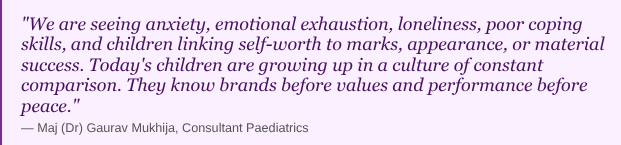
This is not an abstract observation. The data behind it is significant and growing.

A 2025 systematic review covering a decade of research confirmed what many parents sense but rarely name: financial stress, parental distress, and family conflict together disrupt child development and increase emotional, behavioural, and cognitive difficulties — consistently, across income levels, across geographies, in a dose-response pattern. The more financial stress a household carries, the more its children bear the weight of it.
And yet, as The Hans India’s 2026 investigation found: ‘Indirect trauma does not require a dramatic event. It travels through smaller, cumulative signals: a parent who cannot sleep, a conversation that stops when a child enters the room, a phone that rings constantly and is never answered calmly.’
Children do not need to know the numbers. They feel the atmosphere. They read the room. And what they conclude — often silently, often incorrectly — shapes how they think about money, about safety, and about their own worth for the rest of their lives.
The Culture We Did Not Mean to Build
There is a particular pressure that sits on the chest of the modern Indian parent. The pressure to give the best — the best school, the best tuition, the best extracurriculars, the best phone, the best clothes, the best future. It is not greed. It is love, expressed in the only language a competitive economy has taught us.
But somewhere in the race to give the best, something has gone quiet.

The BankBazaar Aspiration Index 2025-26 found that mental health now ranks as India’s top personal priority — above wealth, relationships, and personal growth. And yet the gap between how much Indians value mental health and how prepared they feel to protect it is the widest of any category measured. We know it matters. We do not know how to prioritise it. Particularly not when the bill for the next coaching class is due.
This is the culture we did not mean to build. One where children know their exam rank before they know how to sit with disappointment. One where they know the price of a new gadget but not the value of the money used to buy it. One where they learn to perform — academically, socially, economically — long before they learn to simply be.
The Connection Nobody Is Making — Between Emotional Security and Financial Literacy
Here is the insight at the centre of everything Dr Mukhija and I have been discussing:
Emotional security and financial literacy are not two separate goals for your child. They are the same goal, expressed in two different languages.
A child who feels emotionally safe at home — who is heard without judgment, allowed to fail without humiliation, loved beyond performance — is a child who develops the psychological foundation to handle money well. Because handling money well requires exactly the same capacities: the ability to tolerate discomfort, to delay gratification, to make decisions under uncertainty, to recover from mistakes without shame.
And a child who grows up understanding money — who knows that ₹100 represents someone’s time and effort, who has saved toward a goal and felt the satisfaction of reaching it, and who has made a small financial mistake and learned from it without catastrophe — is a child who develops exactly the emotional resilience Dr. Mukhija is describing.

The word “observe” is doing enormous work in that sentence. Children are not waiting for a lesson. They are already learning — from the tension in the room when the credit card statement arrives, from the pride in a parent’s voice when a good investment pays off, from the shame or openness with which money is discussed or avoided in the home.
The question is not whether your child is being financially educated. They already are. The question is what they are learning.
Two Voices, One Truth — The Paediatrician and the Financial Educator
What makes this collaboration unusual is precisely this: a doctor and a money educator are discovering that they are talking about the same child. Here is where our two perspectives converge:
| 🩺 THE PAEDIATRICIAN SAYS: Holistic child development can no longer mean only physical health and academic achievement. A truly healthy child is one who feels emotionally safe, understands the value of money, respects effort, tolerates failure, and grows into a kind and responsible adult. | 💜 THE MONEY MINDSET LENS: A financially literate child is not one who knows the stock market. It is one who can sit with wanting something they cannot yet have. Who understands that money is earned, not owed. Who has made a financial decision, lived with its consequence, and learned from it without collapse. |
| 🩺 THE PAEDIATRICIAN SAYS: Emotional security is built when children are heard without judgment, allowed to fail without humiliation, and loved beyond performance. | 💜 THE MONEY MINDSET LENS: Financial confidence is built the same way — when children are allowed to manage small amounts of real money, make small mistakes with real consequence, and receive guidance rather than rescue. |
| 🩺 THE PAEDIATRICIAN SAYS: Many children are over-scheduled yet emotionally under-connected. The goal is not merely to raise successful professionals but emotionally resilient human beings. | 💜 THE MONEY MINDSET LENS: Many children are financially over-provided for yet financially under-educated. They have everything bought for them and nothing taught to them. The goal is not a child who has money — it is a child who understands it. |
| 🩺 THE PAEDIATRICIAN SAYS: The future will not be shaped only by intelligent minds but by emotionally secure and compassionate adults. That foundation begins at home. | 💜 THE MONEY MINDSET LENS: The future will not be shaped only by high-earning professionals but by people who know what to do with what they earn. That foundation also begins at home — at the dinner table, in the way you talk about money, in the habits you build together. |
What This Looks Like at Home — Practical Guidance from Both Perspectives
The theory is clear. The practice is what most parents need. Here, between us, is what we recommend:
1. Make money a normal word at home — not a whispered one
The conversations children do not hear are the most damaging. When money is discussed only in tense, hushed tones — or never discussed at all — children fill the silence with their own conclusions. Usually those conclusions involve fear, scarcity, or a sense that money is dangerous and beyond their understanding.
- Talk about purchases out loud: ‘We are choosing the dal over the paneer today because we are saving for our holiday.’
- Let children see you make a budget — even informally. ‘This month we have ₹2,000 for extras. How should we use it?’
- When financial stress is real, name it age-appropriately: ‘Things are a bit tight right now. We are managing it. You do not need to worry — and you do not need to fix it.’
- That last sentence is crucial. Dr Mukhija’s clinic patient was trying to fix his parents’ fights by becoming rich. Children should never carry the responsibility for household financial stress. They should be aware that it exists — and certain that it is not theirs to solve.
2. Let them experience money — not just receive it
The single most effective financial education tool is not a textbook, a workshop, or a conversation. It is the experience of managing a small amount of real money with real consequence.
- Give pocket money consistently — the same amount, on the same day, every week. Inconsistency teaches anxiety. Consistency teaches planning.
- Do not bail them out when they overspend. The discomfort of running out is the lesson. It is better learned at ₹50 than at ₹50,000.
- Let them save toward something they want — and resist the urge to buy it for them while they are saving. The wait is not cruelty. It is the most powerful lesson in delayed gratification you will ever give them.
- Let them give some of it away — to a cause they choose. A child who has experienced generosity with their own money understands money’s relationship to values, not just to transactions.
3. Separate your financial stress from their emotional environment
This is perhaps the hardest recommendation — and the most important one from Dr Mukhija’s clinical perspective.
Financial stress is real, and it lands on parents with genuine weight. But children absorb parental anxiety through the atmosphere of a home, not through explicit information. A parent who is visibly terrified about money — even if they never say a word about it — communicates that terror to their child through sleep patterns, tone of voice, presence, and the quality of their attention.
- Build your own emotional regulation around financial stress — not for your sake alone, but for your child’s developmental environment
- Seek community: financial stress carried alone compounds. Shared, it becomes manageable. This is precisely why spaces that bring parents together around money — openly, without judgment — create ripple effects that reach children
- Distinguish between ‘we are discussing money’ and ‘we are fighting about money.’ The first is healthy modelling. The second is what the child in Dr Mukhija’s clinic was trying to solve by becoming rich
4. Measure childhood differently
This one requires the most courage — because it runs against the current of every school ranking, every competitive exam, every neighbour’s story about their child’s achievement.
| Ask yourself — not once, but regularly: Does my child feel safe to fail in front of me? Do they know that my love is not conditional on their performance? Can they sit with wanting something and waiting for it? Do they understand that the things we have came from work, not from magic? When they feel worried, do they come to me — or do they hide it? Do they know what to do when they make a mistake — with money, with relationships, with themselves? These are the questions of emotional security. They are also the questions of financial wisdom. They are, in the end, the same questions. |
The World They Are Inheriting — And What They Will Need
India’s children are growing up in a moment of extraordinary complexity. A geopolitical crisis has sent fuel prices and gold prices to record levels. The rupee is under strain. The job market is being reshaped by AI. The social media environment measures their worth in likes and followers before they have developed the psychological scaffolding to withstand that measurement.
And yet: the quiet crisis of adolescent mental health in India is not fundamentally a crisis of external circumstances. It is a crisis of preparation. Of children who have been given everything except the inner resources to navigate uncertainty. Who have been protected from failure so consistently that failure, when it inevitably arrives, arrives without any prior experience of recovery.
The world these children will lead does not need more people who performed perfectly in a controlled environment. It needs people who can think clearly under pressure, feel deeply without being overwhelmed, make decisions with imperfect information, recover from setbacks with dignity, and understand that their worth is not the sum of their achievements.

We could not agree more. And we would add only this: those emotionally secure adults will also need to know how to manage their money. How to build an emergency fund and start a SIP and avoid a UPI scam and talk to their spouse about finances without shame. These are not separate from emotional security. They are its expression — in the practical, daily, unglamorous work of building a financially stable life.
A Final Word — From Two Very Different Rooms
Dr Mukhija sees children in a clinic. I work with mothers at kitchen tables and on Zoom calls. We come to this conversation from very different rooms.
But we keep arriving at the same door.
The child who asked whether becoming rich would stop his parents fighting was not asking about money. He was asking about safety. About love. About whether the world he lived in was stable enough to grow in.
The answer to that question is never a bank balance. It is a home where money is discussed without shame, where failure is met with curiosity rather than punishment, where love is not a performance metric, and where children are given the tools — emotional and financial — to meet their lives with confidence.
That is what a healthy child looks like. That is what a financially wise child looks like. And increasingly, we believe they are the same child. 💜
— Prerna Rohilla & Maj (Dr) Gaurav Mukhija
| Build the emotionally secure, financially wise child Parent-Kids Financial Literacy and AI insights Bootcamp June 5, 6, 7 & 8, 2026 | Live Online Morning Batch: 11:30 AM – 1:00 PM | Evening Batch: 4:30 PM – 6:00 PM For parents + children of grade 6–8 | ₹999 per family | 30 families only Led by Prerna Rohilla (MBA Finance) 👉 Register your family at https://mommoneyandmindset.com/bootcamp/ |
Sources & References
Maj (Dr) Gaurav Mukhija: ‘Beyond Marks and Milestones — Raising Emotionally Secure and Financially Wise Children’ (2026, shared with permission) | The Hans India: ‘Is your child absorbing your stress? Understanding indirect trauma in financially distressed households’ (April 2026) | ScienceDirect: ‘The impact of economic crisis on the mental health of children and adolescents: A systematic review’ (2025) | BankBazaar Aspiration Index 2025-26, BusinessToday (February 2026) | Insights on India: ‘The Quiet Crisis of Adolescent Mental Health in India’ (February 2026) | Parliament of India: School dropout data, 2025 | FinCap: ‘The impact of money worries on children’s mental health and wellbeing’ | ASER 2024 Report (asercentre.org)
Pingback: “The Real Examination Begins After School Ends” | Beyond the Balance Sheet – Mom Money Mindset