What PM Modi’s fuel, gold and WFH appeal means for Indian families — and the money mindset it is asking us to build
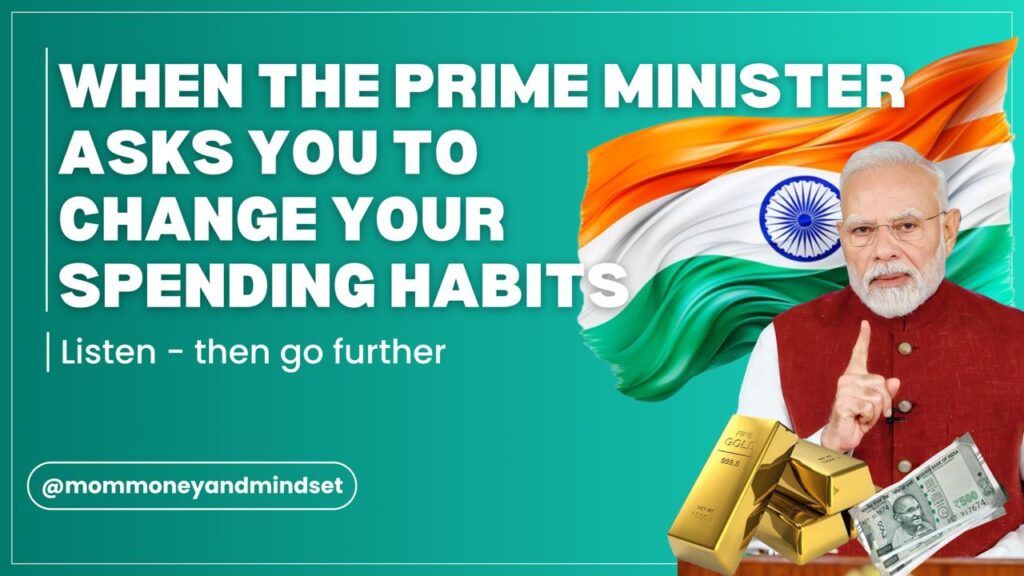
Something unusual happened this week. The Prime Minister of India — speaking first in Hyderabad on Sunday, then again in Vadodara on Monday — asked ordinary Indian families to change three specific things about how they live and spend.
Save fuel. Work from home. Do not buy gold for a year.
These are not the words of a routine budget speech. They are not a policy announcement or a government circular. They are a direct, personal appeal from the head of government to the head of household — to you, sitting at your dining table or scrolling your phone on your morning commute — to make a different choice today.
The backdrop is a crisis unfolding in real time. The ongoing West Asia conflict has disrupted global energy supply chains, sent crude oil prices spiralling, and put significant pressure on India’s foreign exchange reserves and import bill. India imports over 85% of its crude oil, and the country spent ₹72 billion on gold imports in the last financial year alone — the second largest gold import bill in the world after China.
The numbers are genuinely significant. And PM Modi’s appeal — whether or not it produces the national-scale behaviour change he is calling for — contains within it something that goes far beyond the immediate crisis. It contains a financial lesson that every Indian household needs to hear. Not as a response to a geopolitical emergency. As a permanent way of thinking about money.
| PM Modi urges Indians: Work from home, save fuel, defer gold purchases Speaking at Hyderabad and Vadodara, PM Modi called the West Asia crisis ‘one of the worst in a decade’, urging citizens to use public transport, carpooling, online meetings and WFH to cut fuel use — and to defer gold purchases for a year. Source: Al Jazeera & The Week, May 11-12, 2026 |
| Gold hits ₹1.62 lakh per 10g after the government hikes import duty to 15% 24K gold surged to ₹16,201 per gram (₹1,62,010 per 10g) after the government raised gold and silver import duties from 6% to 15% — one of the steepest single-day domestic gold price jumps in 2026. Source: Goodreturns & StartupTalky, May 13-14, 2026 |
| RBI Governor warns petrol and diesel prices may rise soon Oil companies are reportedly losing close to ₹1,000 crore every day at current pump prices. Commercial LPG (19kg cylinder) has already been hiked by ₹993. Retail petrol and diesel hikes are widely expected if crude prices remain elevated. Source: NewsX, May 13, 2026 |
The Real Story Behind the Appeal — Why This Matters to Your Family
Let us start with what is actually happening — because understanding the context is the first step toward responding to it intelligently, not reactively.

India is the world’s third largest oil importer. 88% of its oil imports pass through the Strait of Hormuz — the narrow waterway at the centre of the current West Asia conflict. Any sustained disruption to that passage does not stay abstract for long. It arrives at your petrol pump, your LPG cylinder, your school bus fare, and the price of vegetables at your sabzi mandi.
The SBI’s latest analysis warns that if fuel prices are passed on to consumers — a development the RBI Governor has flagged as increasingly likely — wholesale inflation could rise from the current 3.7% toward 5%, with food inflation potentially rising 10-15% if fertiliser shortages affect the Kharif crop season. Economists estimate a 15% fuel price increase would add an extra ₹750-800 per month to a family using 50 litres of petrol monthly — before accounting for the ripple effect on every other price in the economy.
This is not alarmism. This is arithmetic. And the families that understand this arithmetic — rather than waiting for it to surprise them — are the ones that navigate it best.
“A crisis does not create financial vulnerability. It reveals it. The families that were prepared — with emergency funds, low debt, and intentional spending habits — will absorb this. The families that were not will feel it acutely.”— Prerna Rohilla, Mom Money & Mindset
What Modi’s Three Asks Actually Mean — For Your Money Mindset
The Prime Minister’s appeal is not a financial strategy. It is a national call to consciousness. But embedded within it are three principles that have nothing to do with geopolitics and everything to do with how you manage your household finances — in crisis and out of it.
1. Save Fuel — The Principle of Conscious Consumption
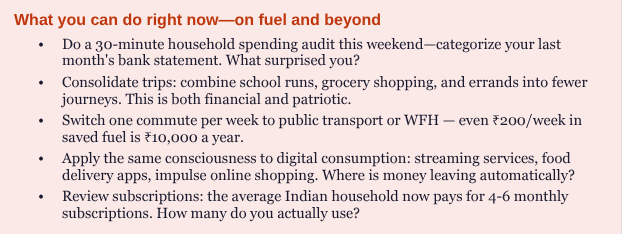
When Modi says save fuel, he is asking India to do something most households have never been asked to do in peacetime: become deliberately aware of a resource they consume automatically.
The financial translation of this goes well beyond petrol. Conscious consumption is one of the most powerful money habits that exists. The family that tracks where its money goes — that knows it spends ₹4,200 on fuel, ₹2,800 on eating out, and ₹1,100 on subscriptions it rarely uses — is a fundamentally different family from the one that watches money disappear without understanding where.
The fuel crisis is an invitation — not just to reduce petrol consumption, but to apply the same consciousness to every rupee you spend. What are you consuming automatically, out of habit rather than intention? Where is money going that you have not explicitly chosen to send it?
2. Don’t Buy Gold — The Principle of Separating Emotion from Investment
This one is the most complex — and the most culturally loaded — of the three asks. Gold in India is not just a commodity. It is tradition, security, status, love, and identity wrapped in 22 karats. Weddings require it. Festivals celebrate with it. Daughters are sent off with it. Grandmothers keep it locked away as the family’s last line of financial defence.
So when the Prime Minister says do not buy gold for a year, he is asking something that cuts across generations of deeply held cultural belief. And the price data adds a sharp new dimension: even as he made that appeal, the government simultaneously raised gold import duty from 6% to 15%, sending the price of 24K gold from ₹15,398 per gram on May 12 to ₹16,789 per gram by May 13 — a single-day jump of nearly ₹1,400 per gram, or over ₹14,000 per 10 grams.
For families planning a wedding or buying gold as a financial asset, this is a seismic shift. For families thinking clearly about their money, it is an opportunity to examine a question they may have never asked before:
| “Is gold in your household a financial asset — or an emotional habit? And do you know the difference?” |
Physical gold in a locker generates no returns, incurs making charges of 10-25% when bought as jewellery, and is now significantly more expensive to acquire. It is illiquid — you cannot quickly redeem 5 grams of gold when your child’s school fee is due. It is vulnerable to theft. And yet Indian households hold an estimated $2.5 trillion worth of it — more than the country’s entire banking system.
None of this means gold is wrong. It means gold needs to be examined clearly — as a financial choice, not an automatic default.
3. Work From Home — The Principle of Designing Your Financial Life Intentionally
This is the ask that carries the most transformative possibility — particularly for Indian women.
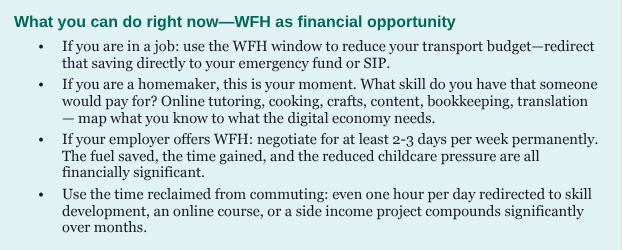
When COVID forced WFH on the world in 2020, it triggered an unexpected secondary effect: many women who had been out of the workforce — because of childcare, in-laws’ expectations, mobility constraints, or simple geography — suddenly found themselves able to earn. Tutoring, content creation, freelance services, online businesses. The removal of the daily commute and the office as the default work location opened professional doors that had been structurally closed.
Modi’s WFH appeal is framed as a fuel-saving measure. It is a reminder that the physical workplace is no longer the only path to financial independence.
As we explored in our guide on financial independence for stay-at-home moms, the digital economy has created genuine earning opportunities that are accessible from home — tutoring, content creation, financial coaching, virtual assistance, freelance services. These are not side hustles. For many women, they have become primary income streams.
The Deeper Lesson — A Nation’s Emergency Is a Household’s Wake-Up Call
Here is what strikes most about this moment.
PM Modi’s appeal is asking Indian households to do things that good financial planning would have recommended regardless of any geopolitical crisis. Reduce unnecessary consumption. Question emotional spending on high-cost, zero-return assets. Embrace flexible, location-independent work. Build resilience into your daily financial habits.
The West Asia crisis did not create these needs. It simply made them impossible to ignore.
And this is the most important financial lesson this moment can teach: the households that feel this crisis most acutely are the ones that had no buffer. No emergency fund. High fixed expenses. Savings that depend on monthly income with no flexibility. Debt that requires every rupee of income to service. Investments that were entirely theoretical rather than actually funded.
The households that will navigate this most smoothly are the ones that built exactly the opposite — not because they predicted this crisis, but because good financial habits prepare you for every crisis, without needing to predict any specific one.
What This Moment Is Asking of Us — As Mothers, as Families, as Women
There is a particular weight this moment carries for Indian women — and it is worth naming directly.
Historically, when household budgets tighten, it is women who absorb the pressure first and most silently. They skip the new sari. They quietly reduce the grocery quality. They manage the school fees one month by delaying something else the next. They carry the arithmetic of household survival without ever having been taught the language of household finance.
A moment like this one — when even the Prime Minister is talking about consumption, spending, and resource allocation — is an opportunity to do something different. Not to manage the crisis in silence. But to use it as the opening for the financial conversation that should have been happening all along.
This week, the dinner table conversation across millions of Indian homes will include some version of: petrol might get more expensive, or gold prices are through the roof, or Modi said we should work from home. Let that conversation go further. Let it include: what is our emergency fund? What does our household budget actually look like? What would we do if income dropped 20% for three months?
That is not a frightening conversation. That is a powerful one.
“A crisis is not a reason to panic. It is a reason to prepare. And preparation is not something you do when the crisis arrives — it is something you build in the years before it does.”— Prerna Rohilla, Mom Money & Mindset
5 Things Every Indian Family Should Do This Week
Regardless of how the West Asia situation evolves, these five actions will make your family’s financial position stronger — this week, next month, and through every future uncertainty.
This Week’s Financial Action Plan
1. Do the 30-minute money audit.
Pull up your bank statements from the last 30 days. Categorise every expense: needs, wants, and auto-debits you forgot about. This single exercise will show you exactly where ₹2,000-5,000 in monthly savings is hiding.
2. Check your emergency fund.
Do you have 3-6 months of household expenses liquid and accessible? If not, this is your first financial priority — before any investment, before any gold, before any upgrade. Open a high-interest savings account and start transferring.
3. Review your gold holding strategy.
With 24K gold now at ₹1.62 lakh per 10 grams and import duty at 15%, buying physical gold right now is buying at all-time highs. If you hold existing gold, consider whether Sovereign Gold Bonds or digital gold better serve your financial goals going forward.
4. Calculate your fuel expense and set a monthly limit.
Know what you spend on fuel every month. Set a target to reduce it by 15-20% through consolidating trips, one WFH day, or a single public transport commute per week. Redirect the saving directly to your SIP.
5. Have the family financial conversation.
Sit down with your spouse — or your children, or both — and talk through your household’s financial position. Income, expenses, savings, goals. Not as a crisis meeting. As a monthly habit. The families that talk about money openly are the families that build it intentionally.
A Final Thought — From One Woman to Another
There is something quietly radical about a woman who, in the middle of a national energy crisis and a gold price shock and a geopolitical emergency, does not wait to be told what to do.
Who pulls up her bank statement and does the audit. Who calls her husband and says let us sit down and look at our finances this Sunday. Who tells her 13-year-old that gold used to cost ₹4,500 per gram in 2015 and now costs ₹16,200 — and asks: can you tell me why? Who decides, right now in this moment of external uncertainty, to build something internally certain.
An emergency fund. A SIP. A clear-eyed understanding of where her family’s money goes and where it should go instead.
PM Modi asked India to change its spending habits. What he is describing — consciously, intentionally, with full awareness of where your money goes and why — is simply what a healthy money mindset looks like. It has always been the right way to live. A crisis just makes it urgent.
The urgency is here. Let us use it. 💜
If this moment has made you want to build a family that is financially prepared for whatever comes next —

👉 Register your family at:
https://mommoneyandmindset.com/bootcamp/
| Related reading from Mom Money & Mindset: 💰 The Stay-at-Home Mom’s Complete Guide to Financial Independence 🏛️ 5 Government Schemes Every Indian Woman Must Know in 2026 |
Sources & References
Al Jazeera: ‘Iran war effect: Why is Modi asking Indians to avoid foreign trips, gold?’ (May 11, 2026) | The Week: ‘Save fuel, work from home, defer gold spending: PM Modi repeats appeals amid West Asia crisis’ (May 11, 2026) | NewsX: ‘Petrol and Diesel Prices Likely to Rise Soon? RBI Governor Warns of Fuel Hike’ (May 13, 2026) | Goodreturns: Gold & Silver Rates Today — 24K gold data (May 13-14, 2026) | StartupTalky: ‘Gold price today India 13 May 2026: Govt doubles import duty to 15%’ | NewKerala: ‘West Asia Crisis: Fuel Prices Key to India’s Inflation Outlook’ — SBI Research Report (May 2026) | Business League India: ‘Is India Staring at an Economic Crisis? 3 Warning Signs’ (May 14, 2026) | RBI Foreign Exchange Reserves data, May 1 2026