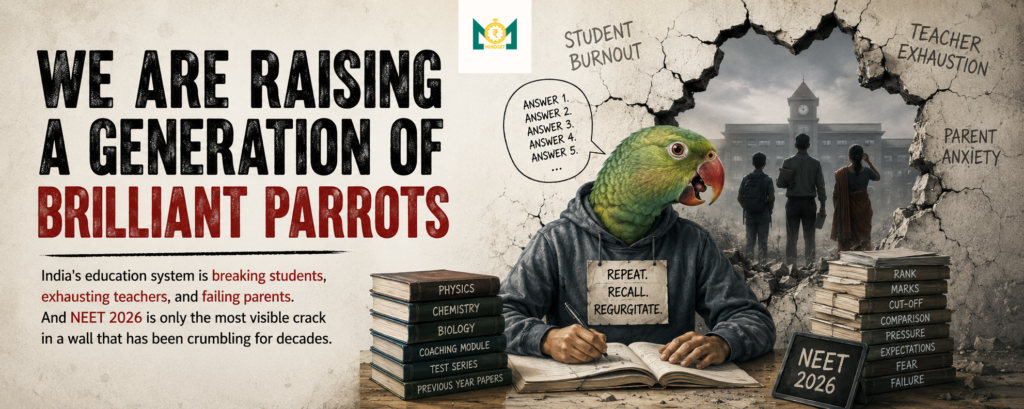
India’s education system is breaking students, exhausting teachers, and failing parents. And NEET 2026 is only the most visible crack in a wall that has been crumbling for decades.
On the morning of May 12, 2026, 22 lakh students woke up to find that the exam they had given their last two years to — the exam their families had spent lakhs of rupees on, the exam some of them had travelled across the country and left their homes for — had been cancelled.
The NEET-UG 2026 paper had leaked. Again.
This time the CBI arrested 13 people — including a doctor in Maharashtra who allegedly helped students access leaked chemistry questions, and a physics faculty member who received leaked questions and passed them on. The Supreme Court was petitioned. Protests erupted. The re-examination was rescheduled to June 21.
For many students, there were no protests. There was just silence.
In the days that followed the cancellation, five more students linked to NEET died by suicide. This brought the 2026 total to at least 14. In 2025, there were 32 such deaths — the highest ever recorded. In the five years between 2021 and 2026, at least 93 students died by suicide in cases linked to NEET pressure.
Ninety-three. In five years. For one exam.
And somewhere in the national conversation about paper leaks, CBI investigations, and re-examination logistics, that number — 93 — keeps getting buried under the administrative noise.
This article is about that number. About what is behind it. And about what we owe every child who is sitting inside a system that was supposed to prepare them for life but is, in too many cases, doing the opposite.
NEET 2026 — The Scandal That Is Not Really About the Paper
The NEET-UG 2026 examination was held on May 3 for over 22 lakh students across 5,400 centres in India and abroad. It was cancelled nine days later when investigators found overlaps between a pre-circulated guess paper and the actual questions — overlaps too precise to be coincidence.
The investigation is ongoing. Arrests have been made. A re-exam is scheduled. And the system, bruised but intact, will grind forward.
But here is what the paper leak is actually revealing — not about the NTA, not about this particular cohort of corrupt insiders — but about the system that makes a single exam worth leaking in the first place.

Think about what that ratio means for a moment. Twenty-two lakh young people — most of them teenagers, many from families who have sacrificed significantly to get them here — competing for seats so scarce that 98% of them will leave without one. That is not a selection process. That is a pressure cooker.
“With over 20 lakh aspirants appearing for NEET every year, the exam has become one of the most competitive and emotionally demanding tests in the country. Becoming a doctor is often viewed as a family and societal expectation rather than a personal choice.”
— The Secretariat, 2024
A family and societal expectation. Not a personal choice. That sentence deserves more attention than it usually gets.
Children are arriving at these examinations not because they chose medicine but because their family chose it for them. Not because they are passionate about healing people but because a doctor is what success looks like in their town, their community, their caste group. The exam does not just test knowledge. It tests the weight of everything a family has poured into a child.
And when that exam is compromised — when it turns out that money could buy what years of effort could not — the collapse is not just academic. It is existential.
CBSE 2026 — When the Reform Becomes the Problem
NEET gets the headlines. But the crisis in Indian school education is not confined to a single entrance exam. It runs through the entire system — and the most recent evidence of this comes from the very reforms designed to fix it.
CBSE’s new two-exam system for Class 10 — introduced in 2026 to reduce pressure by giving students a second chance — has produced a different outcome from what was intended. Teachers across India describe it as a ‘continuous examination loop.’ The academic calendar now runs from February 17 to July 15 — five months of exams, evaluations, and corrections, overlapping with preparation for the next round. ‘We are only thinking about marks,’ said one student. ‘In trying to give CBSE students two chances, the board has left teachers with no breathing space,’ said a Bengaluru school teacher.
Two chances to pass an exam that was always designed to test memory, not understanding. That is the reform.
CBSE, to its credit, has simultaneously launched psycho-social counselling helplines, stress management programmes, teacher awareness workshops, and student wellness activities. In 2026, it mandated schools to prioritise mental health through Capacity Building Programmes twice a year.
These are genuine attempts to address a real problem. But they are also, fundamentally, ambulances at the bottom of a cliff. The cliff — a system built entirely around rote memorisation and examination performance — remains exactly where it has always been.
“One of the biggest misconceptions in Indian education culture is that board exam marks determine a student’s entire future. In reality, success in life depends on many factors such as critical thinking, communication, creativity, and adaptability.”
— CBSE Board Exam 2026: Experts Warn Parents Against Pressure
The irony is exquisite. CBSE itself — the board that administers the exams — is now warning parents that exam marks do not determine a child’s future. While simultaneously administering the exams that most Indian parents and children believe determine exactly that.
The Three People Nobody Is Asking About
Every conversation about India’s education crisis focuses on the system — the NTA, the CBSE, the NEP, the policy. What gets missed in that conversation is what is happening inside the three people who live within the system every single day.
The Student
She is seventeen. She wakes at 5 AM and studies until midnight. She has not read a novel in two years. She cannot tell you what she finds genuinely interesting because the question has not been asked of her recently. What has been asked, repeatedly, is what rank she is targeting.
She knows the mechanism of the kidney. She can reproduce the electron configuration of carbon. She has memorised the dates of every significant battle in Indian history. She has not, in the past three years, been asked to think originally about any of it. To connect it to the world she lives in. To question it. To build something new from it.
She is not being educated. She is being formatted.
The Teacher
He became a teacher because he loved his subject. He has a genuine gift for explaining things, for making the abstract tangible, for watching comprehension dawn in a student’s face. That is the gift he brought into the classroom.
The classroom gave him back a syllabus, a schedule, and a board exam to prepare students for. Then, in 2026, it gave him two board exams to prepare students for. Evaluation weeks that now stretch from February to July. Report submissions and preparation for the next term running simultaneously.
He has not taught for the love of teaching in some time. He teaches to the exam. He teaches what will appear in the questions. He has not had the space to do otherwise.
The Parent
She is sitting in this conversation. She is you.
She did everything right. She chose a good school. She paid for the tuition. She attended the parent-teacher meetings. She tracked the percentages and celebrated the ranks and quietly panicked when either dropped. She told her child that marks aren’t everything — and then spent the rest of the week behaving as though they were.
She is not a hypocrite. She is a mother navigating a system that offers no clear alternative. The message from every direction — school ranking lists, admission requirements, peer group conversations, college cut-offs — is that marks are the currency. She is playing the only game the board has set up.
And somewhere, underneath all of it, she has a nagging sense — quiet but persistent — that this is not how childhood was supposed to feel.
The Rote Learning Trap — Why Memorising the World Is Not the Same as Understanding It
India’s education system is built on a fundamental assumption: that knowledge is a fixed body of content, that students who can reproduce it accurately have learned it, and that the ability to reproduce it accurately predicts future success.
This assumption was already questionable in 1990. In 2026, it is demonstrably wrong.
The world that India’s children are being prepared for is not a world that rewards recall. It is a world being reshaped — rapidly, irreversibly — by artificial intelligence, climate change, global financial volatility, and the kinds of problems that have no textbook answer because they have never existed before.
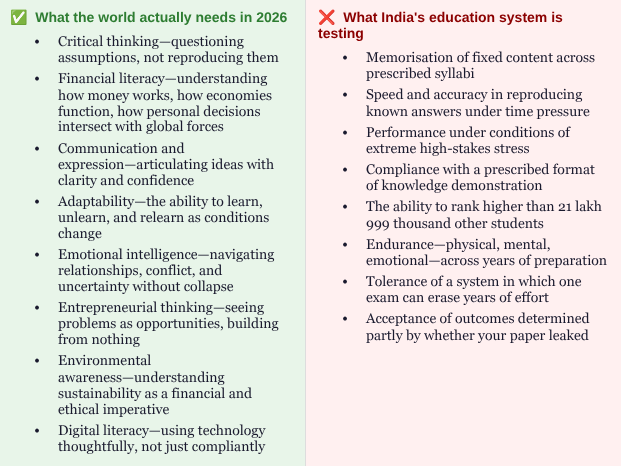
This is not an argument against academic rigour. Rigour is essential. The ability to think deeply, to master a subject, to work hard through difficulty — these are not optional qualities. They are foundational ones.
The argument is about what is being made rigorous. Memorising the right answer from a textbook is rigorous in the same way that lifting a heavy box is rigorous. It develops one muscle. The world requires many.
“The future will not be shaped only by intelligent minds but by emotionally secure, adaptable, and financially wise human beings. And that foundation cannot be built on rote learning alone.”
— Prerna Rohilla, Mom Money & Mindset
The Kota Question — What Are We Actually Asking Our Children to Survive?
Kota, Rajasthan. Population 1 million. Every year, approximately 2 lakh young people between the ages of 15 and 20 arrive from across India. They come to prepare for two exams: JEE for engineering, NEET for medicine.
The city’s coaching industry generates an estimated ₹5,000 crore annually. It has been immortalised in a Netflix series. It has produced IITians and doctors and professionals who populate India’s most prestigious institutions. It has also, according to a 2026 study published in SAGE Journals, a success rate of 2% — meaning 98% of the students who arrive in Kota do not get the seat they came for.
What happens to the other 98%?
Some pivot and rebuild. Most do — eventually. But the years spent in Kota, or in similar coaching ecosystems across the country, leave a mark that is difficult to quantify and easy to dismiss. Years of a child’s life spent in a room, with a textbook, in a city they did not choose, for an exam they may not get.
And for some, it ends in the most irreversible way. Ninety-three documented suicides in five years. Fourteen in 2026 alone — five of them in the days immediately following the NEET cancellation. Students who had given everything and watched it be taken away by a system that could not even keep its own question paper secure.
We owe it to those 93 to say this clearly: their deaths are not the result of personal weakness. They are the result of a system that placed unbearable weight on a single point of failure, told children that this point defined their worth, and provided no meaningful off-ramp when it collapsed.
| A system that produces this outcome is not a system that is working. It does not matter how many toppers it produces, how many IITs it fills, or how many success stories it can display alongside the ones it never mentions. A system that routinely generates this level of despair in the people it is supposed to serve has a foundational problem that tighter exam security and better counselling helplines cannot solve. |
What NEP 2020 Promised — And Where the Gap Still Lives
The National Education Policy 2020 is India’s most ambitious educational reform since independence. It talks about competency-based learning, critical thinking, vocational education from Class 6, flexibility, and life skills. The intent is genuine and the language is progressive.
The gap between the policy document and the classroom is, in 2026, still enormous.
The reason is structural. You cannot put a progressive framework on top of a system whose foundational incentives remain unchanged. If colleges still select on marks, parents will still prioritise marks. If medical seats are still won or lost on a single multiple-choice exam, students will still sacrifice everything for it. The reform changes the language. The incentives remain.
- NEP says: competency-based learning. The classroom still says: what will come in the paper?
- NEP says: holistic development. The report card still says: percentage and rank.
- NEP says: vocational education from Class 6. NEET still says: science stream, 2 years, everything.
- NEP says: financial literacy as a life skill. No major exam in India tests it.
- NEP says: reduce examination stress. CBSE introduces two board exams in the same year.
The reform is real. The implementation is incomplete. And in the gap between them, millions of children are living out their educational years.
What Parents Can Actually Do — Right Now, Inside the System
This is not a call to abandon the system. Your child lives within it and must navigate it. Ignoring board exams and entrance tests is not a strategy. Neither is pretending they do not matter.
But there is a space between surrendering to the system entirely and fighting it uselessly. It is the space where parents make the most important educational decisions of their child’s life — and it has nothing to do with marks.
1. Protect the conversation
The rote learning system can format your child’s school hours. It cannot format your dinner table. The conversations that happen at home — about money, about failure, about what success actually means, about what your child genuinely finds interesting — are the curriculum that no board can take away.
Ask your child: what did you learn today that surprised you? What question did you have that nobody answered? What would you build if someone gave you six months and ₹10,000? These questions are not extracurricular. They are the actual education.
2. Separate performance from worth — loudly and consistently
Every time a mark arrives, there is a choice. The choice is not whether to care about it. The choice is whether your response teaches your child that the mark is a data point — or whether it teaches them that the mark is a verdict on their value as a person.
Children whose parents separate performance from identity are measurably more resilient under academic pressure. They recover from failures faster. They take risks without catastrophising. They try harder because the cost of failure is information, not humiliation.
3. Teach the skills the system refuses to
India’s education system will not teach your child how to budget, how to invest, how to manage a financial emergency, or how to think about money as a tool rather than a measure of success. It will not teach them how to communicate an idea with confidence, how to pitch what they believe in, or how to hold their ground in a room.
These skills are not extras. They are the foundation of the adult life your child is heading toward. As we explored in our collaboration with paediatrician Dr Gaurav Mukhija last week, emotional security and financial wisdom are not two separate goals. They grow from the same root — and they must be cultivated intentionally, because the system will not do it for you.
4. Refuse the single-story future
Your child does not have one path. Not anymore. The world of 2026 offers more genuine paths to a meaningful, financially stable, purposeful life than at any previous point in human history. AI, sustainability, digital commerce, creative industries, health and wellness, financial services, education itself — these are sectors actively looking for young people who can think, communicate, and adapt.
The NEET queue is 22 lakh long for 1.1 lakh seats. The queue for people who are financially literate, emotionally resilient, and able to communicate their thinking clearly is considerably shorter. Consider which queue you are actually preparing your child for.
A Final Thought — For Every Parent Who Felt This
If you read this article and felt something shift — a recognition, a relief, a quiet anger, a concern you have been carrying alone — that feeling is worth paying attention to.
You are not wrong to want more for your child than a rank. You are not being irresponsible by questioning a system that produces 93 suicides for a single exam. You are not naive for believing that a 17-year-old’s value cannot be captured by a multiple-choice question paper.
The system will not change quickly. It may not change in your child’s school years at all. But what happens between these walls — what you teach at home, what conversations you protect, what skills you build together, what futures you expand beyond the textbook — that is entirely within your reach.
India’s children do not need to be brilliant parrots. They need to be original thinkers, confident communicators, and financially aware human beings. They need to be able to fail without fracturing and succeed without losing themselves.
That education is not in the syllabus. It begins at home. And it begins now. 💜
| The system will not change overnight. But your child’s education starts today. 💬 Join Our Mom, Money & Mindset WhatsApp Community! Financial literacy doesn’t have to be overwhelming — especially when you have the right people by your side. 💛 Our WhatsApp community is a safe, supportive space for moms, single parents, teens, and women restarting their journey — where we simplify money, share free resources, and grow together. ✅ Free worksheets & activities for kids ✅ Expert talks on finance & mindset ✅ A community that truly gets you 👉 Click here to join us on WhatsApp Because everyone deserves to feel confident about money. 💪 |
Sources & References
WION News: ‘NEET-UG 2026 paper controversy: CBI identifies actual source of leak; 2 more arrested’ (May 2026) | Medical Dialogues: ‘NEET pressure — 93 NEET-linked suicides in 5 years, 14 cases in 2026’ | The Hans India: ‘NEET Student Suicides Reach Record High in 2025, Kota emerges as major hotspot’ | Careers360: ‘CBSE Board Exam 2026: Two exams for Class 10 exhausting for teachers, cause more anxiety for students’ (October 2025) | SAGE Journals: ‘Mental Health Conditions and Suicide Among Adolescent Coaching Aspirants: Case of Kota, India’ (2026) | The Secretariat: ‘Crisis in India’s Education System Exposed by Student Suicides’ (2024) | CBSE Mental Health CBPs Guidelines 2026 | NEP 2020, Ministry of Education, Government of India | CBSE Psycho-Social Counselling Support launch (January 2026) | PMC: ‘Student Suicide Linked to NEET Examination in India: A Media Report Analysis Study’